
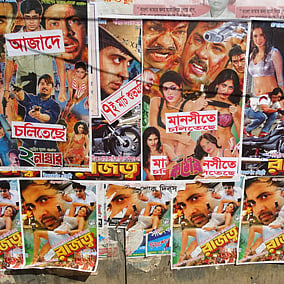
(This is an essay from our September 2015 print quarterly, 'The Bangladesh Paradox'. See more from the issue here.)
"Before destroying a country, they destroy its culture," declared a man wearing a white bandana and black sunglasses in Dhaka in January 2015. "We know our country is free," he continued before the gathered crowd, "but there are still dalals [middlemen] and rajakars [traitors] among us!" The crowd applauded and someone cheered 'Joy Bangla!' "If you want to destroy a nation, you start with its culture and its intellectuals!" he cried. "You have all seen this in the Liberation War!" The audience cheered and enthusiastically recorded the sight and sounds on their mobiles.
The man with the microphone was neither a politician nor an activist, but the hero of nearly every successful action film released in Bangladesh in recent years, Shakib Khan. He was not running for office or lending his support to a candidate, this address before the gathered press and fans was strictly film business. Yet he linked his address directly to the father of the nation, Sheikh Mujibur Rahman. "Bongobondhu [Sheikh Mujib] made a law, that no Subcontinental films could be released here." He added, "Disobeying Bongobondhu, while his party is in power, through illegal means, on the black market, they are releasing these films!" His invocation of 1971, the political transformations wrought by Sheikh Mujib, and the destruction of culture and intellectual life, were all part of a fiery protest against the government's decision to release a handful of Hindi films in Bangladeshi cinema halls.
Banned since the India-Pakistan war of 1965, no Southasian cinema can be screened in Bangladeshi theatres today without special permissions, effectively protecting the national film industry and guaranteeing its unrivalled run in cinema halls. A brief suspension of the ban in early 2010, proposed by the Ministry of Commerce to stall the decay of Bangladeshi cinema halls and perhaps improve trade relations with India, allowed the import of some Indian films. But within days the film industry forced the commerce minister to revert its decision. A lengthy legal tussle ensued and was eventually decided in favour of the importers.