
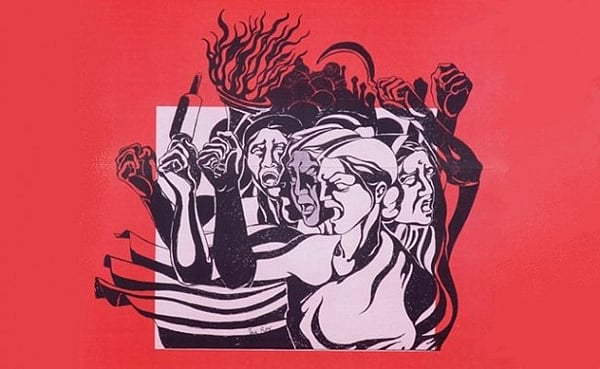
For several decades, women's involvement in various expressions of Hindu nationalist violence has been the centre of controversy in India. The national media has given enormous coverage to the actions and ideologies of political priestesses who have emerged as prominent leaders within the movement. Whether it was Sadhvi Rithambara's venomous speeches urging Hindu men to be virile and eliminate "the Muslim threat", or Sadhvi Pragya's alleged involvement in orchestrating the bomb blasts that shook Malegaon, a small town in Maharashtra, the imagination of Hindu nationalist women as "home-grown terrorists" has continued to capture the attention of the nation. Ordinary Hindu women are also placed at the heart of communal politics, as rightwing rhetoric consistently blames the Muslim community for being historically untrustworthy, carrying out "riot rapes", and promoting hatred against majority religious communities. Several political parties come forward to support and speak for all Hindu women. While the Shiv Sena, the dominant Hindu nationalist political party in Mumbai, criticised the actions of the anti-terrorist squad which arrested Sadhvi Pragya in relation to the blasts, the women's wing of the Shiv Sena, the Mahila Aghadi, distributed chilli powder and pocket knives to women at Mumbai bus stops for their self-protection.
Outside the realm of high politics, female Hindu nationalist cadres continue to informally mobilise men, women and children through either coercion or persuasion. Many urban regions in India are renowned for their prominent schools and colleges that adhere to a regimented vision of Hindu nationalist principles. Most of these institutions are under the purview of women teachers who instill nationalistic values in school children. In many rural areas, Hindu nationalist women play an active role in organising tribal re-conversions or educating tribal communities in the 'superior' culture of Brahmanical Hinduism, all these activities remaining couched in the language of seva, or service to the nation. Whether it is at the centre or at the periphery of the dynamic political landscape of the region, women across rural-urban, class and caste boundaries play a prominent role in creating and sustaining the Hindu nationalist ideology.
Kalyani Devaki Menon's timely book, Everyday Nationalism: Women of the Hindu Right in India, shows how women activists at the grassroots level engineer eclectic constructions of religion, national security, history and social responsibility to make Hindu nationalism appealing to diverse communities. She examines the ways in which women use narratives, ideas and practices to reach out to different social groups, and mould them succinctly to address their everyday fears, desires, needs and interests.
Through an ethnographic study of rightwing women in Delhi (1999-2000) Menon explores this expansionary power of Hindu nationalism, which has successfully marginalised religious minorities in India. Her data is based on participant observation, interviews and conversations with members of the movement, and she has also used pamphlets and other written material published by Hindu nationalists to support her research. The activist women studied by Menon were affiliated with multiple wings of the Hindu nationalist movement, mainly the Rashtriya Swayamsevak Sangh (RSS), the Bharatiya Janata Party (BJP) and the Vishwa Hindu Parishad (VHP). For most women, the RSS constituted the core of the Hindu nationalist movement and other organisations derived their political significance by drawing upon the Sangh's ideological essence.