
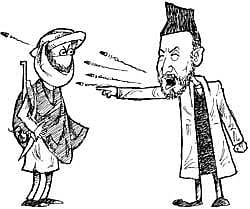
President Hamid Karzai is a man often berated for his weaknesses, both real and perceived. Recently, however, he created a stir by appearing to advocate for military strikes into Pakistani territory in pursuit of militants targeting Afghanistan. In a press conference at the Presidential Palace in Kabul on 15 June, soon after his return from the Paris donors' summit on Afghanistan, President Karzai asserted that his country had a right to strike back at Pakistan-based militants engaged in crossborder attacks. At first reported as signifying a direct threat to Pakistan, the president's statement began to be read as an angry response arising from fast-dwindling patience. But his words were surely far more calculated than mere emotional rhetoric. Indeed, it is beginning to look like a carefully calibrated exercise, laying the ground for military strikes inside Pakistan by international forces stationed in Afghanistan.
Afghanistan has traditionally blamed Pakistan for the violence within its territory, arguing that Islamabad's support to militants was largely responsible for the ongoing conflict. The Kabul government has used this argument time and again to deflect criticism of its inability to curb escalating violence, and to paper over the gaping holes in the government's 'reconciliation strategy'. Headed by the former president, Sibgatullah Mujadidi, the national reconciliation programme has barely managed to chip away at the fringes of the insurgency, bringing in Taliban footsoldiers through surrender or by co-opting arrested leaders. All the while, Kabul has failed to dent – much less break – the backbone of the insurgency.
Apart from expressions of willingness to bring the Taliban into the fold, there has been no clear vision on the purpose of the strategy. Loosely charted as an inclusion of those willing to lay down arms and accept Afghan law, the 'policy' has wavered on the question of who exactly constitutes the target group. With whom the government is actually willing to engage has been variously stated to be moderate Taliban as opposed to extremists; those taking up arms for economic reasons or out of grievance, but not ideologically driven Taliban; those who had not committed heinous crimes versus those with 'blood on their hands'; and, more recently, as the 'indigenous Taliban' versus the 'foreign' (read: Pakistani) Taliban.
This last sentiment appeals to a section of populist Afghan sentiment, which would like to absolve Afghanistan of any responsibility for the ongoing violence. This is the same section that insists that suicide bombing is somehow not part of Afghan culture – as if any other country has had a historic tradition of such attacks. Even categorising the indigenous and 'foreign' Taliban would first require a definition of the international border between these two neighbours, which till today remains contentious, with Afghanistan disputing the so-called Durand Line. The geographical, political and social continuities across the frontier have, in fact, been emphasised by a section of Afghan elites who have advocated a greater 'Pashtunistan', which would include large chunks of Pakistan's NWFP. Such contiguities also found endorsement in the Pakistan-Afghanistan peace jirga of August 2007, which brought together tribal leaders of both countries.