
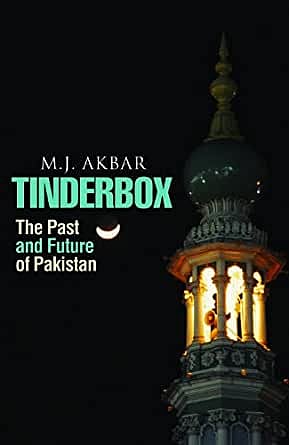
No sooner are we introduced to the rooting of the seeds of Islamic rule in the Northwest Frontier Province and the drive to seek distance from the infidels, than we are informed that 'in a remarkable piece of social engineering, the British turned, through positive discrimination in education, job benefits and political empowerment, a hostile Muslim community into a resource for their Indian Empire within just two decades.' Elsewhere, we discover that in the 1946 elections, swept by the Muslim League, 'its only defeat was in the Frontier.' Further along, Akbar reveals that 'Gandhi's most important associate during the salt agitation was a man from the Frontier,' and many pages later we learn that when the Congress Working Committee accepted Partition, on 2 June 1947, 'only the Frontier Gandhi' – the Pashtun political leader Khan Abdul Ghaffar Khan – 'voted against the resolution. With tears in his eyes he said, "Hum to tabah ho gaye" (We have been destroyed).'
In the last chapter, where the author describes the rise of the Taliban in Swat, he comments: 'It is not entirely coincidental that Sufi Mohammed and Fazlullah – two militant leaders – 'ruled their virtual "Islamic state" in the same "liberated zone" from where Sayyid Ahmed Barelvi and his successor Shah Ismail established "Tehrik-e-Mujahideen" and fought first the Sikh kingdom and then the British in the nineteenth century.' Akbar connects these two dots, separated by almost 200 years, as proof of his thesis, but ignores all the other points in between that belie the storyline.
Akbar records that the intermediary in the British taming of the NWFP was Syed Ahmad Khan, the 19th-century reformer. '[W]hile Barelvi sought salvation through holy war,' he writes, 'Syed Ahmed Khan believed that modern, English education was the only key that could release a community locked in the past.' However, a page later we read that Deoband, the seminary founded by Barelvi's heirs, 'sought Muslim space within a shared Hindu-Muslim India', while the modernists of Aligarh, founded by Syed Ahmad Khan, led the drive for a separate country. Akbar himself remarks on this contradiction when comparing Jinnah and Maulana Azad at another point in the book: 'There is a notable anomaly in the partition drama … The man who had little religion divided India in the name of religion' while the 'true maulana', who 'lived, breathed and practised Islam' opposed Pakistan.