
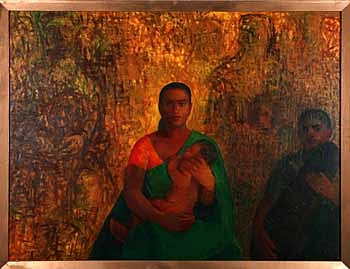
´Hope´: By Chandraguptha Thenuwara
The civil war in Sri Lanka ended on 17 May 2009 with a grave human tragedy, and the plight of war-affected Tamil civilians remains distressing. More than eight months later, many displaced are still living under trees and in roadside tents, their kith and kin still missing. The dead, meanwhile, remain unnumbered; even many among the missing are locked up in detention centres or prisons. The government's military victory over the LTTE has indeed brought relief to many, however – including the northern Muslims, whose sufferings and refugee lives have been neglected for almost two decades by observers of the Sri Lankan conflict.
Although the LTTE faced heavy criticism for this act of ethnic cleansing, LTTE leader Velupillai Prabhakaran was conspicuously silent on the issue during the peace negotiations of 2002-05. Further, none of the parties engaged in talks – including the Norwegian mediators – was willing to even consider the right to collective return of the northern Muslims as one of the primary conditions for establishing normalcy in the north. This was the main reason for the low rate of expelled Muslims' return in comparison to Tamil internally displaced persons (IDPs) return during the last peace process, in 2002.In October 1990, during what is now referred to as the Second Eelam War, some 75,000 Muslims in the Northern Province (five percent of the province's total) were dragged into Sri Lanka's ethnic conflict when they were expelled from their homeland by the LTTE. The rebels gave a 48-hour ultimatum for all Muslims to leave the province; in Jaffna, the provincial capital where the Muslims are concentrated, only two hours was allowed. Each family was allowed to take only SLR 500 and some clothes. Unable to get any transport until they reached towns further to the south, many walked for as long as three days; others were forced to flee without belongings.
Today, however, the dissolution of the Tamil Tiger leadership that ordered the eviction in 1990 has brought new hope to the Muslims of finally being able to return to their homes. Recently, a group of 17 women from the North-Western Province district of Puttalam, where 70,000 northern Muslims have lived in exile since October 1990, organised what they referred to as a 'go and see' visit to Jaffna District. Most of these young women were babies when their community was forced to flee, and had only heard from their elders about how they had once co-existed with the Tamils. One woman in this group, Mubeena, was five years old when her family was evicted; like her peers, she says she has always wanted to return and reconnect with her native place. Mubeena says that over the 19 years she has spent in the Saltern Camp II, she has never felt any sense of permanency. She also worries that until the Muslims return permanently to their northern homes, their suffering will continue.