
Two little boys – one brimming with curiosity, the other a bit fearful – peep through a gaping hole in a wall, the result of a bomb blast on a police post in Nepal. A little distance away are the smiling eyes of Nelson Mandela, offering a glimpse into the story of the South African freedom struggle. These were just two of the photographs that caught the imagination of visitors to the Chobi Mela, held in late January at the Bangladesh National Museum in Dhaka. The fifth instalment of this international photography festival opened with a remarkable video-linked conversation between Indian activist and writer Mahasweta Devi, who was present as the guest of honour, and the American thinker Noam Chomsky, on the festival theme of 'freedom'. Emphasising the role of cultural activists in bringing about societal transformation, Mahasweta Devi said, "We live in an age when people are uniting, protesting all over the world against injustice, and are in search of freedom, which embraces a significant facet – cultural freedom."
With a nod to the anxieties of the times, the festival's view of freedom was neither dogmatic nor over-romanticised. "What mask does freedom now wear?" festival director Shahidul Alam wrote in his introductory comment. "Freedom to profit is the new elixir. Freedom to reach distant markets, to exploit cheap labour. The word that takes us to such dizzying heights leaves the deepest of wounds with its loss. 'Foreign' sounding names, 'wrong' coloured skin, 'different' passports, circumscribe our new freedoms."
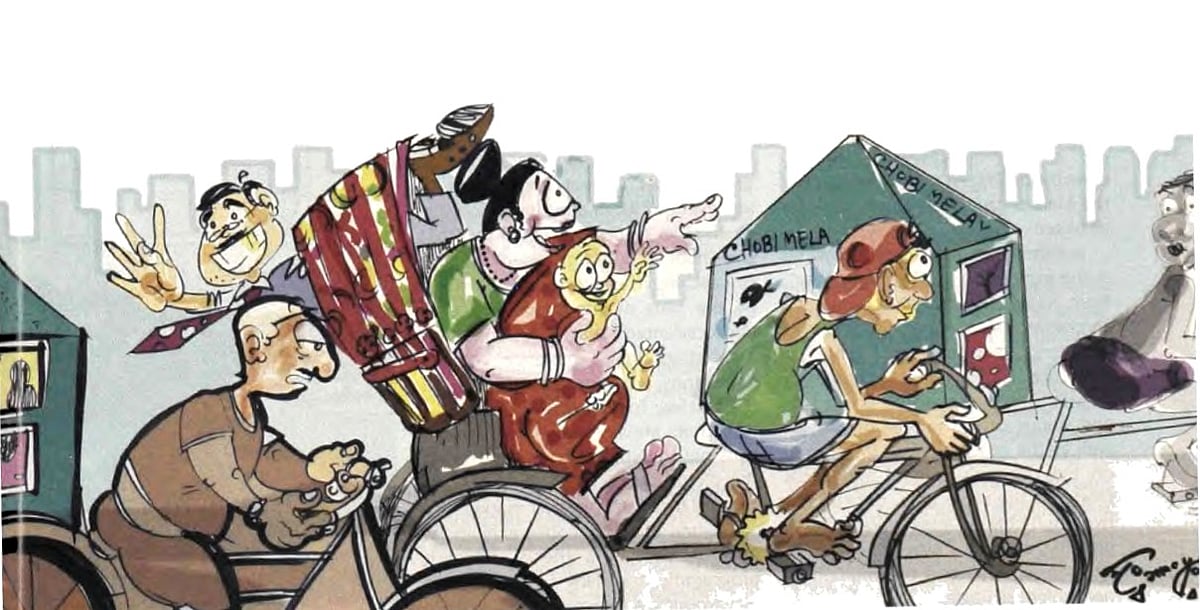
With the photographers interpreting the notion of 'freedom' in myriad ways, extremely diverse imagery was on offer, ranging from comic drawings to a replica of Mandela's prison cell on Robben Island. The highlight, however, was undoubtedly the "Bangladesh 1971" exhibition, featuring the work of veteran photographers Rashid Talukder, Abdul Hamid Raihan, Aftab Ahmed, Bal Krishnan and Mohammad Shafi – images that almost did not even exist any longer. More than a hundred black-and-white negatives of photographs taken by these artists, bearing immediate witness to the period surrounding the War of Liberation, had almost been destroyed by fungus. With this exhibition, the result of the restoration and preservation work that has been done by the Drik Picture Gallery (one of the Mela organisers) was on show for all to see.
Another extraordinary set of images in the exhibition was "A People War", from Nepal. This travelling exhibition chronicles the country's decade-long insurgency, focusing particularly on how the conflict affected ordinary Nepalis. The photos speak powerfully and starkly of the trauma of war, as well as the rending effect that it had on the country's cultural and social fabric. At the same time, the cumulative result of these images was notably uplifting, creating a tapestry of stories of survival, hope and the triumph of non-violent struggle.