
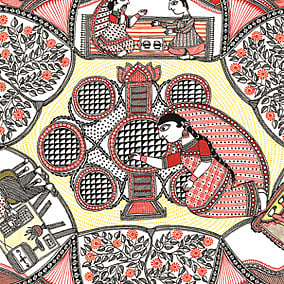
Tara Books, a feminist publishing house located in Chennai, has been collaborating with 'folk' and 'tribal' artists for the last few years to produce illustrated books for both children and adults. Many of the art forms they have worked with are believed to have evolved from women's creative expressions within the household, created for the purposes of ritual and decoration. On the occasion of International Women's Day on 8 March this year, Tara Books inaugurated a photo exhibition titled 'From Floor to Book: Women's Everyday Art Traditions' at their office, the Book Building. The exhibition, which ran until the end of July, traced the journey of select art traditions across the country, from their original contexts to newer canvases and spaces.
A few years ago, Zubaan, another feminist publishing house located in Delhi, showcased artworks by rural women in a travelling exhibition titled 'Painting Our World: Women's Messages through Art' in several cities across the country. As part of Zubaan's larger project of mapping the women's movement through visual material, the exhibition aimed to document rural women's voices on issues ranging from violence, health, communalism and domestic work to marriage, livelihood and the environment, expressed through 'folk' and 'tribal' art and embroidery practices. While Zubaan's exhibition captured the overtly political discursive articulations stemming from the women's movement, Tara Books' concern seems to lie in understanding meaning-making processes of women – the ways in which they comprehend gender and other social relations through the interplay of quotidian and critical consciousness.
Everyday art
The first of the three sections of Tara Books's exhibition is titled 'Everyday Art'. It showcases aspects of an art form difficult to categorise, lying perhaps somewhere at the interstices of craft, art, household labour, tradition and practice. The exhibition shows viewers that women's everyday art is 'created' and 'displayed' in the context of the household, and is by nature ephemeral. Some of the forms are rooted in the religio-ritual universe of women, while others emanate from the gendered labour of household chores. While women from the Gond community of Madhya Pradesh draw basic, geometric digna to decorate their courtyards after cleaning and swabbing, Meena women of Rajasthan paint mandanas on floors, and images of nurture – particularly baby animals with their mothers – on the freshly-painted mud walls of their homes and communities. Kolam is rendered in the threshold areas of Tamil Nadu homes, while women in the cultural region of Mithila (lying both in the state of Bihar, India and Nepal) paint aripana (ritual floor drawing) and kohbar (wedding chamber murals) to mark auspicious occasions and life-cycle rituals.
The exhibition dwells on various facets of this practice. For instance, the kinesthetics (bodily movements) involved in creating the art: from brisk, swift movements, particularly of fingers, as in kolam, to slow, measured, meditative etchings, in the case of aripanas, as if to animate (give prana to) the motif. The other interesting facet of this art underlined in the exhibition is its ephemerality. Kolam is the most ephemeral, the most repeated practice of them all, performed daily, while digna, mandana and aripana are applied to surfaces occasionally. The impermanence of this art reflects the transitory nature of life and human mortality. Time is central to how we experience and organise life, its passage measured by rhythms of domesticity, labour processes and seasonal celebration of festivals, which although repetitive and mundane at one level, also offer opportunities for creative expression. This brings us to another significant aspect of the art underscored by the exhibition: everyday art as creative labour.