
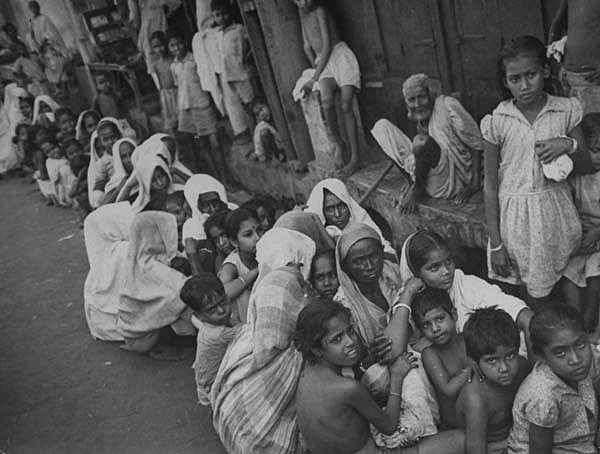
In September 1900, while India suffered through one of the most severe famines in its history, a British official charged with identifying suitable recipients for free food shared his travails with the British Times. "The main difficulty in these inquiries is the unlimited mendacity of the Hindu farmer," he complained. In his experience, many supplicants for aid had "starved themselves into a state of emaciation in the hope that they would receive gratuitous doles, rather than go to work for their living" in a food-for-labour programme. The civil servant went on to describe his interrogation of a typical "starved-looking wretch":
Why is he not working? He says he has not the strength. But why did he not go to work before his strength failed? He pretends he does not understand; he only repeats that he cannot; and he falls on his knees and places his head in the dust and calls you his 'father and mother' and 'protector of the poor.' It is very pitiable – the mental and moral state more than the physical.
The civil servant did not mention that the taxes wrung from these very farmers paid his salary, and would pay his pension when he retired home to Britain. For that would come close to conceding that an imperial system of extortion had maintained India in an almost continuous state of starvation throughout the latter half of the 19th century, as Mike Davis detailed in Late Victorian Holocausts (2001). In that period India suffered a famine every few years, resulting in 25 million deaths even by a conservative count. The proximate cause of the famines was usually drought, although colonial administrators also blamed them on the tendency of natives to breed excessively. (Apart from the mendacity, masochism, indolence and obsequiousness cited by the above official, the alleged attributes of the Indian also included lechery.) But throughout the 19th century India was on average producing enough food to feed its people – which indicates that the roots of starvation lay elsewhere.
Nationalist Dadabhai Naoroji and pioneering economic historian Romesh Chunder Dutt demonstrated that British Indian famines arose from the way the colony had been forcibly incorporated into the global economy. High taxes, which had to be paid even when the crop failed, forced farmers to relinquish to the market whatever harvest they could gather – and to the moneylender or taxman almost all the cash they thereby earned. As a result, the poor had too little money left in hand to buy enough grain for their own needs. Their ever-diminishing purchasing power relative to consumers abroad, in concert with rigorously enforced free-trade policies, ensured that a substantial portion of the surrendered harvest left the colony's shores. As Dutt calculated, each year India exported agricultural goods equal in value to the cereal requirements of 25 million people. These exports, in turn, earned India the foreign exchange to pay the Home Charge: the administrative and other expenses that the colony owed Britain for the privilege of having white men shoulder its burdens. By the end of the Victorian era, the Home Charge came to 20 million pounds a year.