
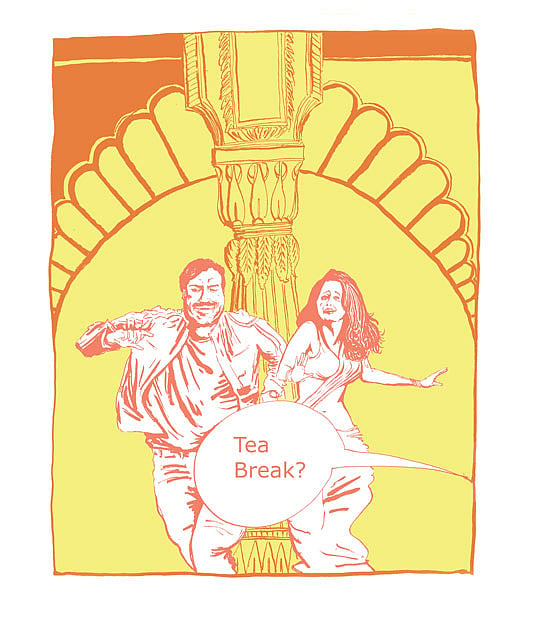
One of my most vivid memories of watching Hindi films in the 1980s – at home, on a video-cassette player – was that almost each time a song came on, someone would get up to press the fast-forward button. Or we would let the scene play out but it would be treated as a breather, allowing us to see to other things for five minutes: one of us might take a bathroom break, another would go and check on the food cooking on the stove.
It should be mentioned that the 1980s was generally a poor time for Hindi film music, and the movies I mainly watched as a child were revenge-and-violence sagas where music played a perfunctory role. The songs tended to be tuneless and the cinematography uninspired. Our viewing habits did change a little when melody (some of it plagiarised) crept back into Hindi cinema in the late 1980s, with teen romances like Qayamat se Qayamat Tak and Maine Pyaar Kiya. But in general, songs were treated as fillers.
Perhaps this attitude wasn't restricted to that time: perhaps it has always been a part of the wider snobbery directed at popular Hindi cinema, even by viewers who enjoy watching it as a guilty pleasure. There is a telling scene in Basu Chatterji's 1974 film Rajnigandha, a gentle and thoughtful example of so-called 'middle cinema', which occupied a niche between the dramatic excesses of mainstream movies and the stark minimalism of 'art films'. In the scene in question, the talkative Sanjay (Amol Palekar), having carelessly entered a movie hall long after the film started, wastes little time in getting up again for some fresh air when a song sequence begins on the screen in front of him. "Dekho gaana aa gaya, main thoda ghoom ke aata hoon" he says, "Oh look, a song, I'll go out and walk around for a bit."
Emotional depths and poetic truths