
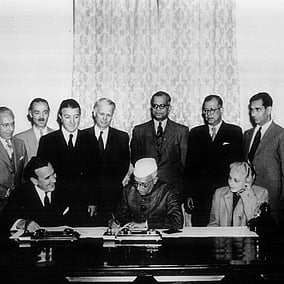
Nehru could be the democratic ruler he was because once in office he faced so little opposition… Subjectively, any prospect of a dictatorship was alien to Nehru. But objectively, it was also quite unnecessary, so little temptation ever arose.
– Perry Anderson, The Indian Ideology
As Prime Minister Narendra Modi personalises Indian politics, to an extent not seen since Indira Gandhi's time in power, comparisons have inevitably been drawn with the first such political personality of independent India, Jawaharlal Nehru. As the quote from Perry Anderson's book shows, an axiomatic feature of such commentary is the taken-for-granted omnipotence of the central deity. First Nehru, then Indira, now Modi: hero-worshipping Indians, it is said, get their just desserts.
However, were Nehru and Indira then, and Modi now, really all-powerful? Can anyone be so in the complex political democracy that is India? Louis Fischer, a distinguished American liberal journalist, an old India hand and, as an acclaimed biographer of Mohandas Gandhi, no stranger to the Indian public and its leader fascination, came to India in autumn 1952 with this belief and was unpleasantly surprised. Unpleasantly because, from being a disciple of Gandhi during the battle between nationalism and imperialism in mid-1940s, Fischer had transformed into a critic of Nehru for his non-aligned stand in the Cold War in the early-1950s. Between 13 August and 24 September 1952, Fischer was in India, travelling to major cities and meeting a cross-section of the Indian political and economic elite. He kept a diary on this visit (ten years since his first visit to India in the halcyon days of the Quit India movement of 1942), which is available in his papers at the Seeley G Mudd Manuscript Library, Princeton University. The common theme of these diary entries is a reluctant admission by this Nehru-baiter that India's first prime minister was neither all-knowing nor all-powerful, as it seemed from afar to Fischer and many of his fellow Americans.