
There is a high-stakes drama playing out in India these days, and the novelist Arundhati Roy is one of its most visible actors. Multinational companies, in collusion with much of India's upper class, are lining up to turn the country into one big franchise. Roy puts it this way: "Is globalisation about 'the eradication of world poverty', or is it a mutant variety of colonialism, remote controlled and digitally operated?"
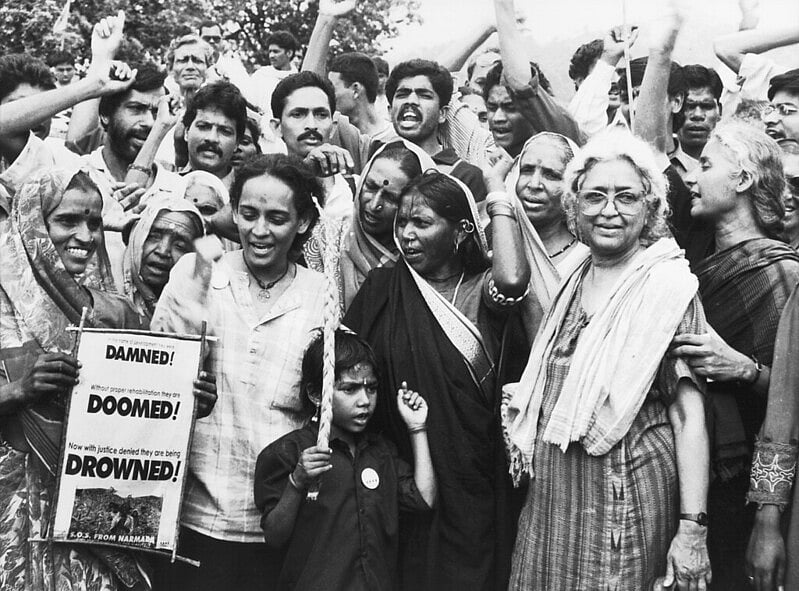
Roy lives in New Delhi, where she first went to become an architect. But she's not working as an architect or even as a novelist these days. She's thrown herself into political activism. In the central and western states of Madhya Pradesh, Maharashtra, and Gujarat, a series of dams threatens the homes and livelihoods of tens of millions. A huge, grassroots organisation, the Narmada Bachao Andolan (NBA), has arisen to resist these dams, and Roy has joined it. Her devastating essay on dams, "The Greater Common Good", and her searing denunciation of India's nuclear testing, "The End of Imagination", have literally kindled bonfires. The upper class didn't appreciate her critique of development, and the nationalists abhorred her for questioning India's nuclear arsenal. (These two essays comprise her latest book, The Cost of Living, Modern Library, 1999.)
Her most recent essay is called "Power Politics". In it, she takes on Enron, the Houston-based energy corporation that is a large financial backer of George W. Bush. In India, Enron is trying to take over Maharashtra's energy sector. The scale of what is happening, she says, makes California's power woes look like child's play. On a cold, mid-February afternoon, Roy gave the annual Eqbal Ahmad lecture at Hampshire College in Amherst, Massachusetts, before a huge crowd. It was a powerful, political talk, and afterward she was besieged by a long line of mostly young South Asian women, many of whom are studying at one of the five colleges in the Amherst area. She donated her lecture fee to earthquake relief in Gujarat. The next morning, I interviewed her in the back seat of a car taking her from Amherst to Logan Airport in Boston. The two-hour drive went by in a flash.
David Barsamian: You grew up in Kerala. What's the status of women there?