
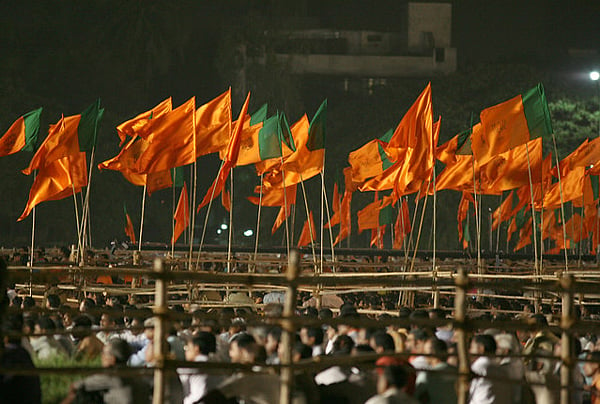
It was once common wisdom that India had succeeded in developing a viable form of Westminster-style parliamentary democracy whereas Pakistan had failed. Pakistan has indeed suffered a succession of military governments interspersed with periods of nominally civilian rule; as such, it is not a model worthy of emulation. But the rise of Hindutva politics has taken away the starkness of earlier comparisons. Even if there is little danger of military rule in India, the viability of a system where political success lies in appealing to the basest of human instincts and to the availability of vast sums of money, is questionable.
When the two sovereign countries emerged in 1947 neither had any experience with the process of democratic governance. Literacy rates were low, production was largely agrarian and there was no mega resource like oil. Both countries comprised disparate regions with a multitude of different languages, landscapes, climates and cultures. Yet, in time, they managed to invent their own national identities and constitutions.
Formally both countries are democracies. But what democracy means and which sections of the population may enjoy democratic representation, is being continuously redefined as the decades roll by. India's 900 million eligible voters – numbering more than the entire population of Europe – are presently at polls scheduled to end on 19 May 2019. Whereas the Bharatiya Janata Party's (BJP) Narendra Modi is the front runner, a resurrected Rahul Gandhi is giving the Congress a fighting chance. The outcome will significantly redefine India.
The Indian elections are more important for India than Pakistan's were for Pakistan. Pakistan, with 106 million registered voters, concluded its elections on 25 July 2018 with the election of Imran Khan as prime minister. While many of his naïve supporters were promised otherwise, it was unreasonable to expect fundamental changes. Whoever was to win would be secondary, the military would continue making all the big decisions on foreign policy, nuclear weapons and would continue to gobble up national resources. Indeed for all the 'Naya Pakistan' rhetoric from Khan, little change is visible nine months later.