
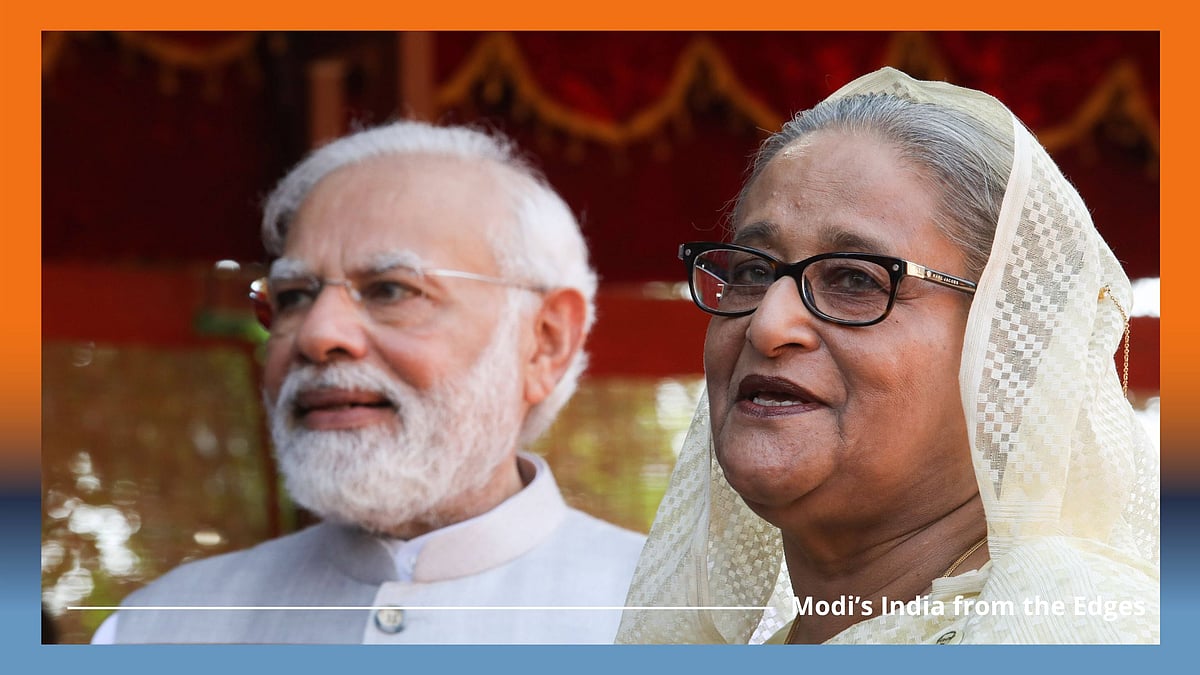
This story is part of ‘Modi’s India from the Edges’, a special Himal series presenting Southasian regional perspectives on Narendra Modi’s decade in power and possible return as prime minister in the 2024 Indian election. To read the series and support Himal’s work on it, click here.
In the run-up to Bangladesh’s general election in January 2014, New Delhi took the unusual step of sending a top diplomat from its external affairs ministry to Dhaka to persuade General Hussain Muhammaed Ershad, the country’s former military ruler, to participate in the polls. Big questions had been raised over the fairness of the election. The incumbent government was led by Sheikh Hasina’s Awami League, and the leader of the opposition Bangladesh Nationalist Party (BNP) had been placed under virtual house arrest, with police and roadblocks around her house in Dhaka. The BNP and other opposition parties were threatening to boycott the election. Ershad, the head of the Jatiya Party, was perceived as a potential kingmaker, able to bring to power whichever of Bangladesh’s two main parties he supported, but he was also threatening to withdraw from the election.
He later told reporters that the Indian diplomat’s purported reason in asking for his participation was to prevent the rise of the Jamaat-e-Islami, a hardline Islamist party and an ally of the BNP. However, India’s move was seen as trying to legitimise a one-sided election. This marked a pivotal moment in the relationship between the two countries, as the action was widely interpreted as direct Indian interference in Bangladesh’s domestic politics with the aim of bolstering a favoured strategic political ally in the Awami League. He told it years later
In that election, 154 out of the 300 parliamentary seats had a single candidate standing due to the boycott, resulting in the Awami League securing a majority even before voting commenced. With support from New Delhi, where the Indian National Congress-led United Progressive Alliance (UPA) was then in power, Hasina reneged on her promise of a subsequent new election and a political resolution to the question of the conduct of elections in Bangladesh. Earlier, the country had followed a system where a caretaker government took power at election time to ensure fair polls – but Hasina had abolished this in 2011, fuelling the opposition’s protests of foul play. The broken promise after the boycotted election triggered a prolonged period of governance without a viable opposition. And despite expectations of a shift in New Delhi’s Bangladesh policy following the transition of power in India in 2014, when the UPA gave way to the National Democratic Alliance led by the Bharatiya Janata Party (BJP), India’s support for Hasina remained steadfast. Throughout the ten years of Indian government under the BJP and Narendra Modi, this has remained unchanged.