
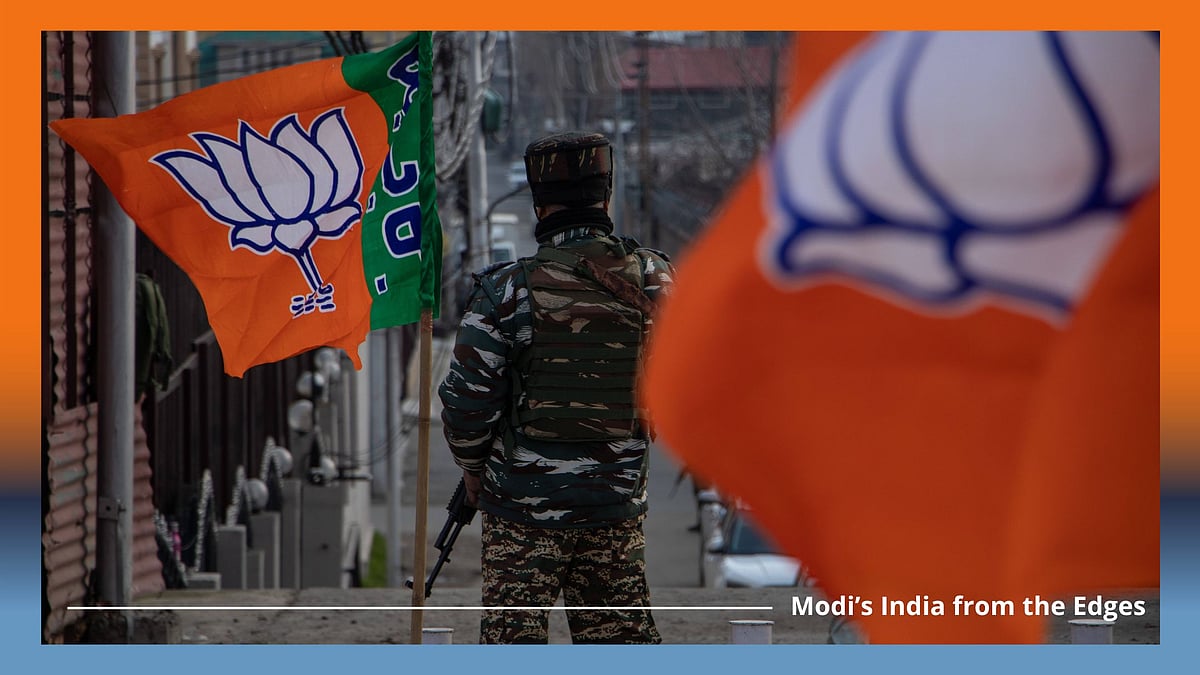
This story is part of ‘Modi’s India from the Edges’, a special Himal series presenting Southasian regional perspectives on Narendra Modi’s decade in power and possible return as prime minister in the 2024 Indian election. To read the series and support Himal’s work on it, click here.
Since 1947, when Kashmir acceded to India, the distance between New Delhi and Kashmiris has been marked by mutual suspicion and a large trust deficit. Over decades, New Delhi eroded Jammu and Kashmir’s autonomy and manipulated its local politics. New Delhi has also viewed Kashmir only through the prism of security, resulting in an ultra-nationalist gaze on the region. In India-administered Kashmir, this has crystallised into a deeply embedded sense of betrayal linked to the historical dispute over the territory. But despite the unhealed wounds and the apprehensions of forced demographic change in India’s only Muslim-majority territory, Kashmiris felt, from time to time, hope for the possibility of a settlement of the Kashmir dispute.
These hopes began to recede when the Narendra Modi-led Bharatiya Janata Party (BJP) government assumed power in New Delhi in 2014, and they faded much faster when the BJP entered into a coalition with the regional Peoples Democratic Party (PDP) in 2015 to rule the state of Jammu and Kashmir. To the dread of Kashmiris, the right-wing BJP made sudden inroads in the state via the consolidation of the Hindu vote bank in Jammu province.
With Modi at the helm since 2014, the Rashtriya Swayamsevak Sangh (RSS), the ideological parent of the BJP, has realised one of its oldest ideological ambitions – the revocation of Article 370 of the Indian constitution, which recognised Jammu and Kashmir’s unique past, endowed it with special status and protected the exclusive rights to land and jobs of the people of the erstwhile state. Moreover, the subjugation of Kashmiri people has increased manifold in the last decade of Modi’s rule, and the tyranny of the state and the military has become more sophisticated.