
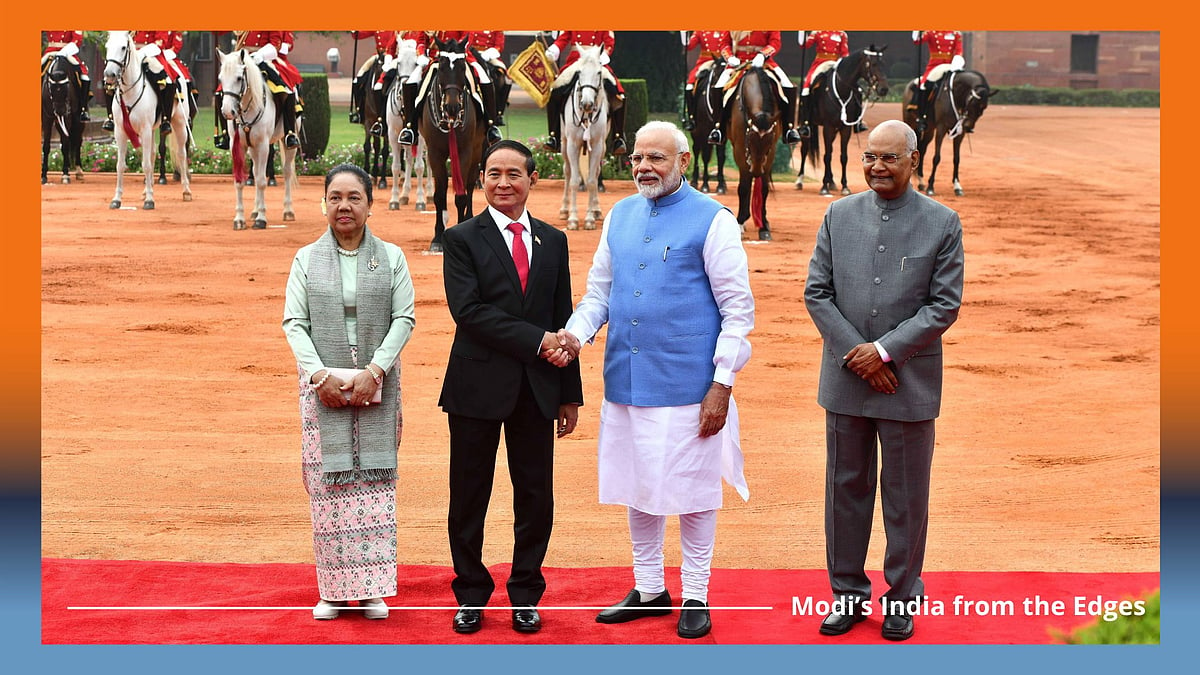
This story is part of ‘Modi’s India from the Edges’, a special Himal series presenting Southasian regional perspectives on Narendra Modi’s decade in power and possible return as prime minister in the 2024 Indian election. To read the series and support Himal’s work on it, click here.
In November 2014, just months after taking charge as the prime minister of India following a high-voltage election, Narendra Modi made a somewhat intrepid announcement at the 12th India-ASEAN Summit. “A new era of economic development, industrialisation and trade has begun in India,” he said. “Externally, India’s ‘Look East Policy’ has become ‘Act East Policy’.” While the precise contours of the policy were not clear then, Modi’s intent was obvious: expanding India’s ties with Southeast Asia. What was equally, if not more, significant about the announcement was that he made it in Naypyidaw, the sprawling capital of Myanmar.
One day before his announcement, Modi had met Myanmar’s president, Thein Sein, a retired general who was then the head of the country’s quasi-civilian government. The next day, right after unveiling the Act East Policy at the summit, he met Aung San Suu Kyi, Myanmar’s best-known political figure and, back then, the chief of the National League for Democracy (NLD). A year later, the Lady, as Aung San Suu Kyi was popularly known, won a thumping victory with her NLD in Myanmar’s first “free and fair” national election in many decades, and became the head of a new civilian government.
Modi, it seemed, had made his moves at the right time. In fact, his Myanmar dash was an indication of how India was preparing to deal with a key neighbour that had been a working partner for New Delhi for a long time but was now in the middle of tectonic transformations. He had set the tone for India–Myanmar relations for the next few years. For those listening, New Delhi’s message was loud and clear: it was ready to engage with Naypyidaw no matter who was in power.