
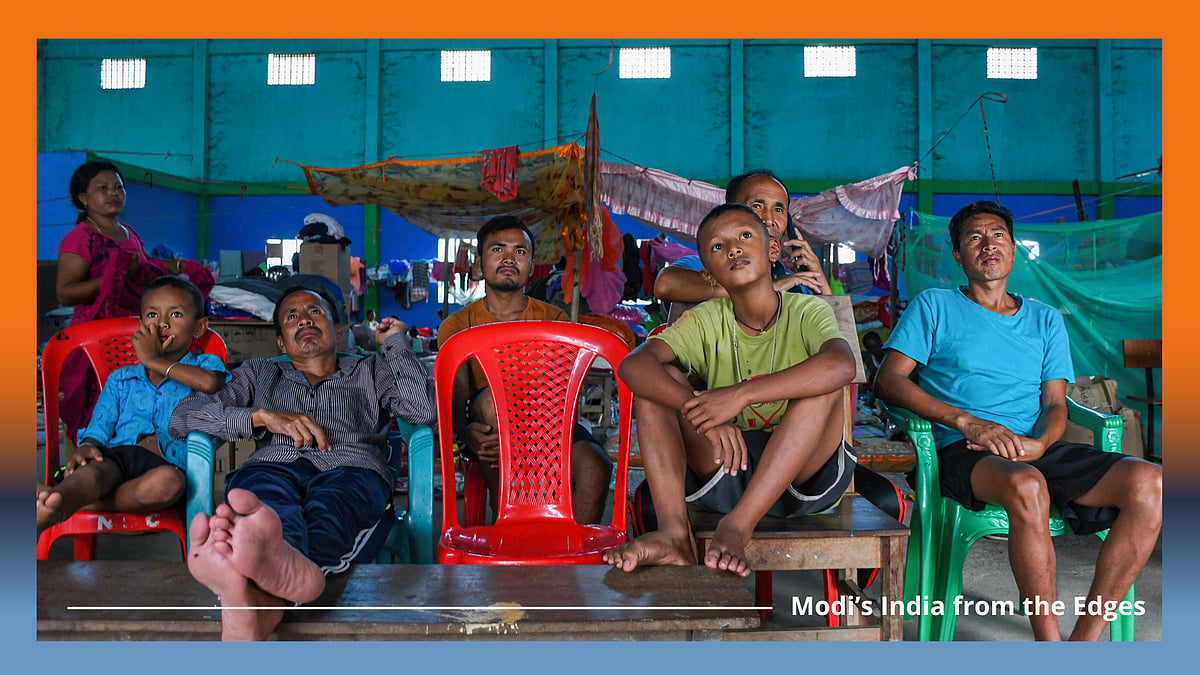
This story is part of ‘Modi’s India from the Edges’, a special Himal series presenting Southasian regional perspectives on Narendra Modi’s decade in power and possible return as prime minister in the 2024 Indian election. To read the series and support Himal’s work on it, click here.
In March, India’s prime minister, Narendra Modi, said at an election rally in Arunachal Pradesh that previous governments had not cared for states that sent only two representatives to the country’s parliament, as Arunachal and several others in the Indian Northeast do. Modi failed to see the irony of his claim given that he has not visited Manipur, which has only two representatives in parliament, since the outbreak of an armed ethnic conflict that has raged on for nearly a year. The toll from the violence stands at more than 200 lives lost, and many thousands displaced.
In India’s 2024 national election, widely seen as being decisive for the country’s democracy, the eight states in the Northeast – Assam, Sikkim, Arunachal Pradesh, Manipur, Mizoram, Nagaland, Tripura and Meghalaya – will decide whether they want to be part of “Modi ka parivar”, or Modi’s “family” – a phrase that Modi’s Bharatiya Janata Party (BJP) has rolled out on social media as an election gambit. The BJP-led central government in Delhi has repeatedly claimed to have bridged the “tyranny of distance” between the Northeast and the rest of India, something that the region has undoubtedly long suffered from. Unfortunately, the Modi government’s handling of the Manipur crisis shows otherwise – and none of the BJP’s numerous political partners in the Northeast region, who often profess themselves to be “sons of the soil”, have challenged the government’s claim.
The Northeastern states combined send only 25 representatives to Lok Sabha, the 543-seat lower house of the Indian parliament. Assam, the most populous of the states, accounts for 14 of these alone. The perceived remoteness of these states, connected to the rest of India by only a narrow “chicken’s neck” of a corridor in West Bengal, is another factor that has kept the region on the fringes of national politics. What’s more, the Northeastern states are among the country’s poorest – with the exception of Sikkim, which has the highest per-capita net domestic product of any Indian state – and among those most heavily dependent on central funds. In fact, the central government has a ministry dedicated to the development of the Northeast, going by the acronym DoNER, which channels 10 percent of the annual budgets of all 52 central ministries to infrastructure projects in the region. Regional experts often remark that the Northeast is compelled to follow Delhi’s lead because of this historical dependence on the centre.