
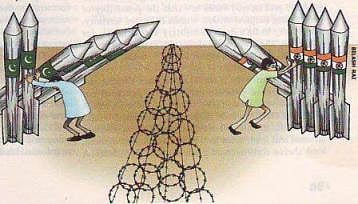
India's remarkable macro-economic turnaround since the early 1990s has put it on the pat to global recognition. Yet several incisive commentators have noted in recent times that the country continues to be held back from realising its true potential because of unresolved political tensions with its neighbours, especially with Pakistan, the second largest player in the region. Indeed, India's relationship with Pakistan has largely come to shape the geopolitics of the region as a whole. Given the overbearing size of the two economies and their military strengths, these two countries alone largely dictate the extent of integration possible within the region as a whole. It is therefore no surprise that persistent hostilities between New Delhi and Islamabad over nearly six decades have left Southasia as economically one of the least integrated regions across the globe.
That the future of the Southasian region largely depends on the course India-Pakistan relations end up taking is a given. The utmost importance being accorded to the ongoing peace process is therefore warranted; but there is also the suggestion that a successful end to the peace bid would automatically lead to complete 'normalisation' of relations. The two 'automatic' outcomes suggested are a move away from high military expenditures and enhanced economic ties, with the latter also providing ready means for enhancing people-to-people contact.
This premise is incorrect. The peace process will lead to no more than an opening to continue on the path to normalisation. Before the latter can be achieved, two major concerns will have to be addressed: the ever-increasing disparity in military balance vis-à-vis India, and India's potential to flood Pakistani markets economically when trade ties are liberalised. While both of these are long-term concerns, and their outcome could well decide whether Pakistan and India manage to co-exist as peaceful neighbours, by no means will they be direct results of the peace process. A distinct, equally elaborate process will have to be followed to achieve these ends.
Neighbour-specific militaries
Let us begin by considering the issue of disparity in military strengths. In absolute terms, India's conventional military spending and capability is substantially greater than Pakistan's. Ignoring the tactical elements of warfare, an objective macro analysis of the two sides' military capabilities leaves no doubt that India could overwhelm Pakistani defences with little difficulty. The nuclear option then acts as a potent deterrent for Pakistani military planners, to some extent thwarting the possibility of Indian adventurism. Notwithstanding the liberal view that the presence of nuclear weapons ought to lessen the pressure for conventional military expenditure (and that, if not, they should go), an outright emphasis on nuclear weapons is virtually impossible – and dangerous – given the geographical contiguity between the two sides. In essence, Pakistan cannot divorce its nuclear capability from the excessive disparity vis-à-vis India in the conventional realm.