
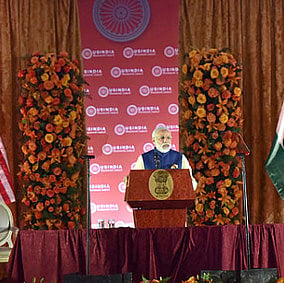
The combination of Narendra Modi's elevation to prime minister of India and the widely known fact of the Indian diaspora's financial support of the Hindu Right have resulted in the revival of a familiar question: what is wrong with all these non-resident Indians (NRIs) who seem to love the Bharatiya Janata Party (BJP)? While not exactly forgotten before the election, the Indian diaspora is subject to a kind of hyper-remembering, now that it is seen to have played a part in bringing about a Modi-led government at the Centre. Notably, the diaspora takes up far more space in conversations and media representations today than during the last BJP-led National Democratic Alliance government, in power from 1999 to 2004. The hyper-remembering is likely to continue as this BJP-led government makes it clear that the diaspora is to be an important cog in India's revamped economic engine. Modi's fête in New York's Madison Square Garden in September 2014 was the public relations inauguration of this declaration, another symbolic starting gun for the dubious economic race that 'Moditva' intends to win.
In trying to explain why US-based NRIs, in particular, love Mr Modi and the BJP, the age-old theories of immigrant nostalgia and a crisis of identity are enjoying a strong resurgence. As an article in Scroll.in claimed, "Modi's enviable popularity among non-resident Indians is perhaps linked to his emergence as an ostensible resolution to the identity crisis they experience in foreign countries. Most of these NRIs will never relocate to India even as they pine for it, both as an aspect of their memory and as the principal fount of their cultural identity." The author ends the piece by saying that NRIs' interactions with the Sangh Parivar are "driven by feelings of insecurity and inferiority". The argument is clear: Modi, in his own person, lights the way for insecure NRIs, modelling that you can have prosperity and Hindu-Indian identity at the same time.
The conflation of Indian Americans, in particular, with wealth has also gone a long way toward explaining the embrace of Hindutva in the Western reaches of the diaspora. The association between the wealth of US-based Hindu NRIs and Hindutva is not unjustified, although it bears repeating that Indians in the US are an extremely class-diverse group. Over the past decade, several reports have demonstrated the extent to which Indians in the US have provided significant financial support to the Sangh Parivar since the 1990s, tracking those Indians who have money to give, and who choose to give it either wittingly or unwittingly to the Hindu Right. It almost goes without saying that Gujarati Hindus in the US have participated in these fundraising efforts, as a community that has come to be associated with affluence, 'Moditva', and rightwing Hindu politics almost as a natural state of being. However, a problem arises when all of these theories – nostalgia, personal insecurity, and affluence – are squeezed together in the same framework, as if Hindu Indians in America are a wealthy, nostalgic, and anxious lot who seek validation through filling their local Swaminarayan Temple's collection plates.
The dynamics are fundamentally complex, and cannot be explained away by linking nostalgia, insecurity and affluence, a set of associations that begin to crumble at the slightest touch. For example, it bears noting that affluent Indian professionals in the US of any community are generally comprised of people who did not emigrate with their wealth in hand. If they are affluent today, it is because they have been in the US long enough to become so. How 'insecure' are these individuals, families and communities, given how established they have become? In what way would this 'insecurity' manifest? To be sure, in speaking of the upper-caste Hindus among these immigrants, these are people who have generally supported the BJP, both rhetorically and financially, but this information does little to supply us with an explanation for its cause. 'Nostalgia' might be of some help here, but to say that affluent Indians in the US are 'nostalgic' for India also falters when one sees the very low numbers of Indian immigrants who return there to live. Much has been made in academic studies of the hybridity of immigrant identity, the no-man's land of being neither here nor there, which produces, among other things, nostalgia for the world one leaves behind. I would draw on this insight to argue that there is something deeper at play here, given that the world one leaves behind inevitably changes, dramatically, from the moment of departure. For most middle- and upper-middle-class Hindus of Indian origin in the US today, supporting the BJP in the 21st century taps less into a nostalgia for the home that was; rather, it taps into a nostalgia for what might have been. This is nostalgia not for India as it is imagined to have been before one left, but nostalgia for the fantastical possibility of never having left at all, of never feeling that one had to leave in order to gain economic and, perhaps more importantly, class mobility. This fantasy is the real prize the BJP is selling the diaspora when it makes grand promises of a vibrant, economically powerful, 'developed' India, and arguably what the Indian American diaspora is buying, hand over fist.