
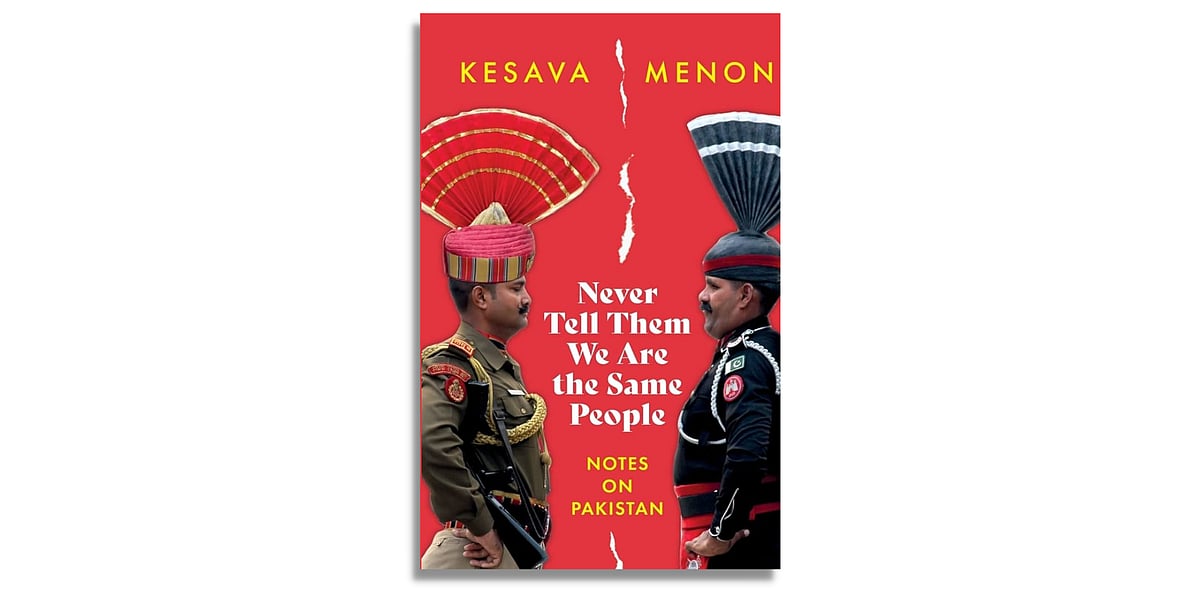
The veteran Indian journalist Kesava Menon's Never Tell Them We Are the Same People: Notes on Pakistan, a memoir of his time as The Hindu's Pakistan correspondent from July 1990 to October 1993, is just that rare thing. Published earlier this year, the book comes three decades after the period it describes, but Kesava maintains that, given the emotional intensity of his experiences, the passage of time has helped him produce a more balanced account. Kesava is remarkably honest: he makes no attempt to hide the anger he carried within himself when he was asked to go to the Islamic Republic of Pakistan. Before this, he had been "covering the second phase of the Khalistan insurrection for about five years and the Kashmiri militancy since its outbreak in April 1989." Pakistan was widely thought to be stoking both phenomena, and Kesava writes that he held it responsible for engineering "carnage" in India. He acknowledges that he had preconceived notions about Pakistan by virtue of being an Indian, yet as a journalist he also had to examine his conditioning while being cautious to not "become overly sympathetic to a nasty neighbour."
From this point of view, Kesava writes about Sindhi wrestlers, Punjabi bureaucrats, Malayalis running cigarette shops, bootleggers, politicians, Gandhara art, caste consciousness, teledramas in which Hindus and Sikhs are shown plotting against innocent Muslims, and much else. Though he was based in Islamabad, he had opportunities to travel to Rawalpindi, Taxila, Lahore, Karachi, Thatta, Mohenjodaro and Swat. On occasion, an official from Pakistan's Press Information Department would call up to chat and "then deliver his punchline, which was something more than a message yet far from amounting to a threat," suggesting that Kesava soften his reporting. Certain areas remained completely out of bounds because of his nationality: notably Balochistan, home to a long-running separatist movement, and Gilgit-Baltistan, administered by Pakistan but also claimed by India. Still, he got to see more of Pakistan than almost any Indian journalist could dream of then or now, with a level of access that seems unimaginable today.
Kesava had the chance to meet Hamid Gul, a former three-star general of the Pakistan Army who headed Inter-Services Intelligence (ISI) – Pakistan's main intelligence agency, much loathed in India for its suspected ties to numerous Islamist militant groups and meddling in regional affairs. Kesava initially saw Gul as a "propagator of the jihadi ideology that ISI and a good chunk of the regular office cadre had apparently internalized," but was taken aback by the man he encountered. "My first surprise was to discover that the spymaster with an ogre's reputation was actually about the same size as me," he writes. "The second was that he was soft not only in speech but, from what I could make out, in physique as well." In their first interaction, "With one of my hands gripped in one of his and the other arm draped on my shoulder," Gul asked Kesava "whether it would not be wonderful if India and Pakistan could resolve the Kashmir issue and get along like the friends they were meant to be." Kesava took this to be in earnest, and was left stumped.