
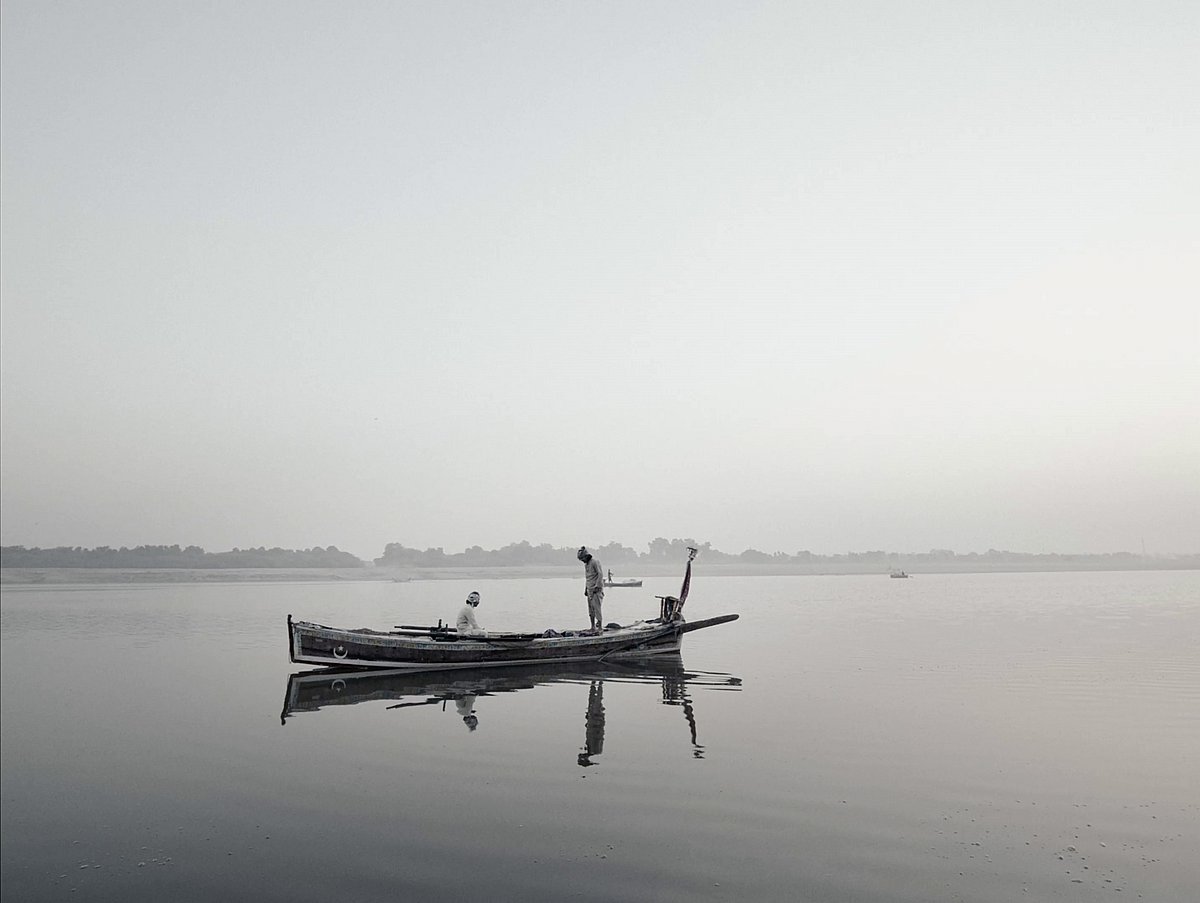
AT MULTIPLE POINTS during the Sindhi-language film Sindhu Ji Goonj (Indus Echoes), I fought the urge to fill in the silence between the characters’ dialogue with my own memories of brief trips to the banks of the Indus River. On the way to Thatta, a district near Karachi where my grandmother is buried, I recalled that the waters of the Indus had been murky and grey despite a clear sky. The fact that it was flowing was visible only if you looked carefully at how fallen leaves and branches curved downstream. Rahul Aijaz’s film takes the river’s seemingly stagnant but actually never-still waters and brings them to the big screen.
From 11 September, the day before the Pakistan release of Indus Echoes, I was impatiently checking for when it would finally come to Karachi. My impatience washed away as I finally sat down for a screening on 19 September. The film, after all, is a test in patience. It demands that the viewer look and speculate; it also assumes they will be able to follow along without the need for exposition.
(My gripe with much of Pakistani commercial cinema is that it often does the opposite. Directors feed the viewer fast-paced, excessively dramatic dialogue paired with simmering background music that leaves no room for ambiguity within the plot.)
Indus Echoes is special for several reasons. It is the first Sindhi-language film to be released in Pakistani cinemas in 28 years, making it the first of its kind for Sindhi youth of my generation. It is also a unique co-production between creatives based in Pakistan, Bangladesh, South Korea and Ecuador. Yet, despite this being a landmark production, reception was muted in Karachi. I counted just eight people in the roughly 150-seat hall when the movie began on its opening night in the city. By the end, the number went up to only around 25.