
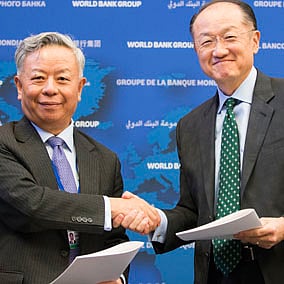
At the end of June 2015, 57 prospective member-states gathered in Beijing to sign the articles of association for an institution that China had first mooted in 2013, the Asian Infrastructure Investment Bank (AIIB). At the time of its launch, 50 countries had signed the bank's charter, and another seven were waiting for final domestic approval. China had managed to win the endorsement of a large number of countries, including the UK and those in Western Europe. Headquartered in Beijing, the development bank was formally launched by President Xi Jinping on 16 January 2016.
This widespread endorsement was telling, since the run-up to the launch was fraught with controversy. When the AIIB was formally announced on 24 October 2014, only 20 countries had agreed to be its founding members. The US, UK, Japan, South Korea, and Indonesia were not on the list. It included a few countries from Central Asia and West Asia, members of the Association of Southeast Asian Nations(ASEAN) excluding Indonesia and five countries from Southasia – India was the largest non-Chinese founding member.
Despite the fact that Beijing had put out an open invitation to join the new initiative, and many countries like Australia, Indonesia and South Korea had expressed an interest, there was limited participation. Something or someone had dampened that interest, leading to the no-shows in October. However, matters changed between October 2014 and June 2015, with many countries that had expressed scepticism or said they would "wait and watch", changing their minds and joining the AIIB as founding members. There was a rush of applications as the deadline approached.
The final tally of 57 applicants, though lower than the World Bank's membership of 188 and the Asian Development Bank's (ADB) 67, was significant given the concerted US campaign against the bank. The US refused to join on the grounds that the governance of the bank would not meet 'required' standards, with China having a veto on decisions and the likelihood that the impact of financed projects would not meet international safeguards on environment, labour and human-rights. The US also campaigned vigorously to keep its allies, principally the UK, European countries like Germany, France and Italy, and Asia-Pacific partners such as Japan, South Korea and Australia out of the AIIB. In the event, of these countries only Japan stayed away.