
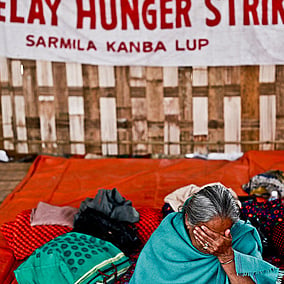
On 2 November 2014, Irom Chanu Sharmila's fast in protest against the Armed Forces Special Powers Act (AFSPA) entered its 15th year. For much of this time, Sharmila has been held by the state for the crime of 'attempted suicide' under Section 309 of the Indian Penal Code (IPC). On 19 August 2014, she was acquitted of this charge by a local court in Imphal, though just two days later she was re-arrested on the same charges. On 23 January of this year she was once again released, only to be re-arrested the very next day. This cycle of release and re-arrest is as old as her fast.
The government's 10 December announcement that it would repeal Sec. 309 of the IPC and hence de-criminalise 'attempted suicide' was welcomed by both local and international human-rights organisations. For Irom Sharmila, this development could have far-reaching implications. If the IPC is amended, Sharmila can no longer be arrested on these charges.
Within this wider context, the 24 January arrest of Irom Sharmila makes little sense if the government's announcements are taken at face value. The arrest clearly suggests that despite the government's stated desire to repeal Sec. 309, their willingness to use the statute remains. According to a report in the Indian Express, "after [Sharmila's] health deteriorated at 9 pm [23 January] last night, the Manipur police, who had been guarding her around the clock, rushed her to the Jawaharlal Nehru Institute of Medical Sciences in Porompat. 'This is not an arrest, we are taking her for medical treatment,' said SP Imphal West Ibomcha Singh. This afternoon [24 January], however, the police produced her before the magistrate and remanded her under section 309 of the IPC."
The common perception in India is that Sharmila is being punished for protesting AFSPA (which the Indian state does not want repealed). Though this has merit in terms of the state's broader intent, it has no legal basis. Technically, Sharmila is being punished for what the state deems is her attempt to commit suicide. This distinction is important.