
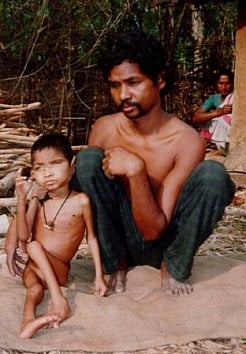
For the past four decades, the indigenous Santhals of Jaduguda, in Jharkhand's Singhbhum District, have lived in the massive shadow of the Uranium Corporation of India Limited (UCIL). India's ambitious and much-discussed nuclear programme is based on uranium mined in this area. In the villages of Jaduguda, most families have at least one member working in either the UCIL mill or the mines. As a result, people in Jaduguda enjoy a degree of prosperity unusual in this impoverished Indian state.
But it is hard to say that this relationship has been a positive one. Ill health is widespread, and accidents can occur anytime. Indeed, on 24 December 2006, in Dungridih village near Jaduguda, a pipe burst, discharging radioactive waste into a nearby rivulet. The pipe was being used to move the waste from a UCIL plant to a storage dam. No alarms went off at the plant, nor did anyone from the mill bother to warn the village people about the leak – although some Dungridih villagers did quickly alert UCIL officials. Lethal sludge continued to leach into the water for nine hours, killing fish and affecting nearby and downstream communities that depend on the watershed for both fishing and irrigation. Anil Kakodkar, the head of the Indian Department of Atomic Energy, when he visited Jaduguda in early February, noted only that there had been a "small" leak in the pipeline, and hastened to note that it was of no risk to anyone.
In the wake of the disaster, the Jharkhand Organisation against Radiation (JOAR), a local resistance group set up in the mid-1990s, has demanded that UCIL decontaminate the soil and water. According to Shri Prakash, a local documentary filmmaker and activist, the company has removed some of the sludge, but much of it remains on the banks, covered by mud.
It is still not clear why the pipe burst. Nor did UCIL make any effort, then or later, to provide an alternative supply of water to the affected community. But all this does not surprise the people here. They have a long history of battling UCIL and the fallout of its uranium mining. Although it is something of a monopoly employer and has an overwhelming presence here, official probes have found that UCIL does not observe even routine precautions when it comes to the lives and health of the local people. Workers, for instance, regularly take their uniforms home, to wash them casually at local water sources. This is not so much due to workers being unaware, but because UCIL provides them with no washing facility on site.