
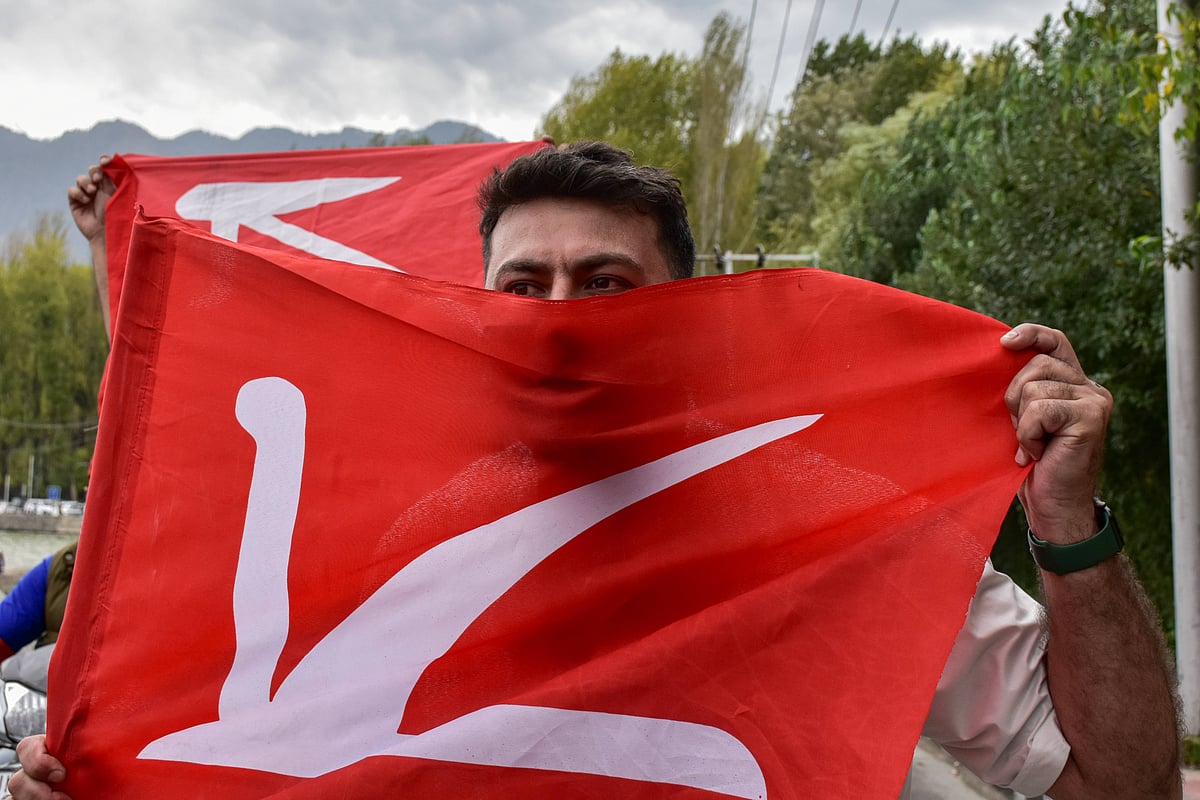
As soon as the Jammu and Kashmir assembly election results were announced on 8 October, the Kashmir Valley erupted in celebration, with people dancing and singing on the streets, lighting firecrackers and distributing sweets. The reason to celebrate: they had thwarted the Hindu nationalist Bharatiya Janata Party’s efforts to register its first win here, which the ruling BJP government in New Delhi would have used to “justify” its 2019 revocation of Article 370 of the Indian constitution, and with it Jammu and Kashmir’s special status and statehood.
“We were robbed in broad daylight of our identity,” Hilal Ahmad, a businessman, quipped before he cast his vote. “Downgraded and disempowered by the BJP. Now it’s time to register our protest.”
Instead, a regional party, the Jammu and Kashmir National Conference, swept the election, winning 42 seats out of 90 seats under vote. The Indian National Congress, its alliance partner, got six seats, and the Communist Party of India (Marxist) won one seat. This was enough to keep the BJP out of government, even if the party did win 29 seats in the Hindu-dominated Jammu region. The result is likely to mean challenges ahead for the national BJP government, particularly given that the new chief minister of Jammu and Kashmir, Omar Abullah, has voiced support for restoring the territory’s statehood.
Abdullah had not initially planned to contest the assembly election. The stripping of statehood in 2019 had reduced Jammu and Kashmir to a union territory, governed by a Lieutenant Governor appointed by New Delhi, and Abdullah was unwilling to act as the chief minister of a union territory with limited powers. “I can’t see myself in a position where I have to ask the L-G to pick my peon,” he told the media, or “sitting and waiting outside for him to sign the file.” But, on 16 October, Abdullah took oath as Jammu and Kashmir’s new chief minister. For him, too, like for the territory he now nominally heads, the present circumstances promise many difficulties ahead.