
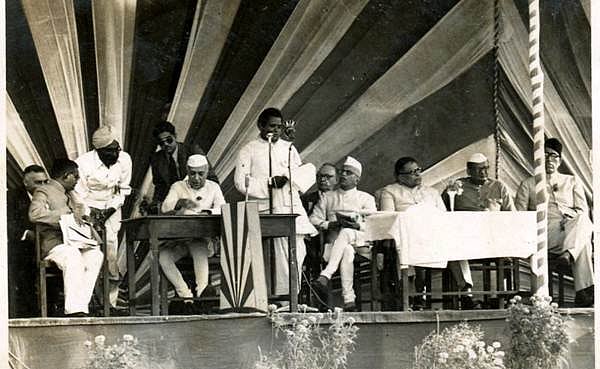
In 1952, my parents, Pran and Soni Prashad, left Calcutta, India for Japan. They had been married for four years, and two children had already been born to them; two more would come later. Both my parents lost out on higher education – my father because his studies were interrupted by World War II, and my mother because she was married at 18. My father went to work at the Calcutta docks for a large British-Indian firm, Bird & Company. In the years after Indian Independence, my father's rise in the company was assured. He was a large personality who impressed people easily and whose ambitions were in line with what old firms in new countries needed. My mother supported those ambitions effortlessly, and with good humour. Their trip to Japan marked them, my father especially. Afterwards, his entire approach to life seemed driven by the desire to turn India into Japan.
Bird & Company had extensive interests in eastern India, from coalmines in Bihar to jute factories in the industrial belt that went up the Hooghly River north of Calcutta. From its offices in Dalhousie Square (today Kolkata's B B D Bagh) to its mode of operations, Bird & Company seemed to have resisted eviction from the 19th century. But my father was not a man who liked to look backward, and he was not particularly impressed by the traditions of the old English 'box-wallah' firms. He looked elsewhere for the future.
When I was a little boy, years later, my father would tell me about Japan. His hands, with a cigarette lodged between the fingers, would dance around his head as he sketched out the remarkable history of that small island nation. The story always began with the ships of US Navy Commodore Matthew Perry breaching Japanese pride and protection to enter Tokyo harbour in 1853, engendering the crisis that would become the Meiji Restoration and setting Japan on a course not only of national discovery and modernisation but also, crucially, of industrial growth. Near at hand on my father's table was Alfred Toynbee's A Study of History, one of the touchstones of his self-education, where Toynbee wrote that the Samurai who ruled Japan at the time of Perry's arrival were Japan's creative minority, fighting for four centuries to "redeem their past" by trying to convert "feudal anarchy into feudal order." During the Meiji Restoration, the Samurai performed the highest kind of "self-abnegation by giving up their privileges to help the country modernise fast."
We Prashads and Pasrichas did not come from feudal stock. My ancestors drew their incomes from government salaries, mainly as writers and petty administrators in Lahore and Peshawar (except for one with mysterious roots in Burma). My father was frustrated by the privileges of the Indian Samurai – the aristocracy and their coterie, with their corruption and their chamchas [bootlickers]. He wanted to see more self-abnegation and less involution of wealth and desiccation of talent.