
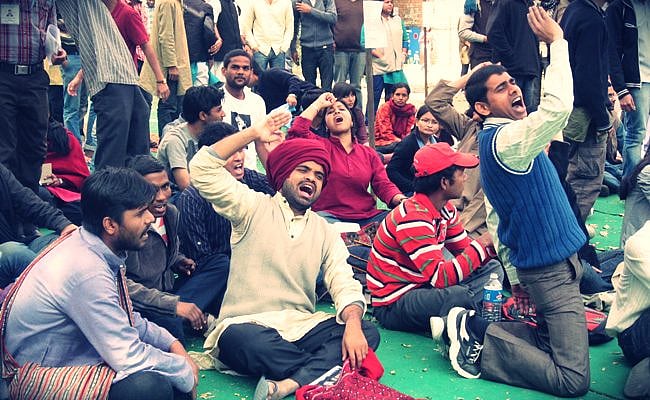
The quiet, tree-lined walks of the academic block of Jawaharlal Nehru University (JNU), where the usual sounds are of murmuring voices and birdcalls, have for the last several weeks reverberated with purposeful footfalls, high-pitched sloganeering and counter-sloganeering. JNU has been showing all the signs of a politically rejuvenated campus. On 1 March, the rush of political activity included the widespread distribution of pamphlets, as campaigning reached a crescendo. This was a red-ticket day in the history of JNU, when nearly two-thirds of the student body voted for the JNU Students' Union (JNUSU), injecting life into a body that has been in the political wilderness since the Supreme Court of India put a stay on JNU student elections, in 2008.
The ban arose because a section of students had disagreed with certain recommendations made by the 2006 J M Lyngdoh Committee. This official body had looked into the conduct of student-union elections in colleges and universities throughout India, and many of the recommendations drew student ire. These included calls for the dissociation of student groups from political parties; the prohibition of printed canvassing materials; and an age limit for graduate, postgraduate and research students. Certain sections were particularly vocal in their opposition to the recommended 10-day limit on the duration of elections, an age limit of 28 for research students, a cap on the number of times a student could contest elections, and specific attendance requirements that could disqualify individuals from being considered students – and hence from contesting or voting in student elections.
Despite the ban, JNU students kept up efforts to restore the JNUSU. Their struggle culminated in December 2011, when the Supreme Court agreed to reinstate union elections, provided they adhered to the spirit of the Lyngdoh Committee recommendations. The Supreme Court also agreed to certain relaxations; the age limit for research students was extended up to 30, for instance, while permission was granted to circulate photocopied campaigning materials within a stipulated budget. The much-contested attendance requirements were also relaxed.
So, over the course of the subsequent three months and amidst great enthusiasm, the recent elections saw a rush to politicise current students. After all, most had never witnessed a JNUSU election and had only passing familiarity with the various student organisations and their ideologies. When the vote finally took place, the student mandate was overwhelmingly in favour of the All India Students' Association (AISA), the student wing of the Communist Party of India (Marxist-Leninist) Liberation. The AISA clinched the JNUSU's top four offices as well as 14 councillor seats in the various schools. Coming in second for the office positions was the Students' Federation of India (SFI), the student wing of the Communist Party of India (Marxist), and its partner the All India Students Federation. But they still trailed the AISA candidates by margins of 500 to 1300 votes, and could clinch only three councillor seats. Finally, the Akhil Bharatiya Vidyarthi Parishad (ABVP), the student wing of the rightwing Rashtriya Swayamsevak Sangh (RSS), won six councillor seats, while the Congress-affiliated National Students' Union of India managed just four.