
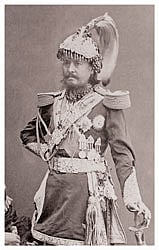
The current confusion in Nepal is not unique in the context of the chaotic nation-building processes of the rest of Southasia. Yet, the country's 19th-century history was significantly different. At that time, most of the smaller but stronger states of India were disappearing, one after another, from the political geography of the Subcontinent. British power in the region had reached its height, in large part due to its unchallengeable military supremacy. In this scenario, Nepal was the only country in the region that was able to maintain an independent existence, by resisting the military hegemony of the British colonial might in India.
While aspects of historical personalities might indeed be critiqued even centuries later for their possible failings, the role of individuals in the shaping of states bequeathed to the present generation must be acknowledged. Among such personalities linked to the building of Nepal were the founder king Prithvi Narayan Shah, his son, Bahadur Shah, and the shogun Jung Bahadur. Each of these played important roles in making Nepal a strong state, and in maintaining its independence such that, in modern times, the citizens would have the ability to build a society on the basis of sovereignty. The successful military campaign launched by Prithvi Narayan Shah of Gorkha, for its territorial expansion, was by far the most important event in the history of Nepal. Through this military campaign, more than 100 princely and feudatory states scattered within the territory of present-day Nepal were brought under the control of a single unit. The early rulers of the consolidated Nepal – which was actually an enlarged Gorkha – seemed eager to accept the historic name of 'Nepal', in order to refer to the entire territory that they had brought under the control of the kingdom of Gorkha.
Prithvi Narayan Shah was not the only stalwart of his dynasty. His youngest son, Bahadur, also distinguished himself in military campaigns meant for territorial expansion, which was the raison d'etre of the fledgling state. The names of several Gorkhali commanders and army officers – including Shivram Singh Basnet, Kalu Pande, Kahar Singh Basnet, Ramkrishna Kunwar, Bakhtabar Singh Basnet, Amar Singh Thapa, Bhakti Thapa and Balabhadra Kunwar – are equally important in recalling this period of military-led expansion. History provides a reminder that a strong state of Nepal, which was capable of resisting at least three major invasions by its giant neighbours, British India and China, was not least a result of Gorkha's strong military strategy and force projection, based on guerrilla tactics. Indeed, it was due to this historic feat by the early rulers and officials of the country, united through military might, that the inhabitants of diverse ethnic backgrounds were able to preserve their historical and cultural traditions. This might seem an incongruous statement amidst all of the talk of the Gorkhali state having subsumed all ethnicities and regions through the expansionism of the Khas (Nepali) language; but it is also true that Nepal's ability to remain independent and isolated actually helped identities remain distinct all the way into the modern era, which began for Nepal in 1950.
Thus secured from external invasion, Nepal became a safe haven for traditions of both Vedic and Buddhist origin. Believing that the Hindu and Buddhist traditions of the Indian Subcontinent were under threat by external or non-Indic cultures and practices – ie, Muslim and European (Christian) – Prithvi Narayan Shah took pride in creating a safe state (rajya), where local traditions and cultures of the Himalaya and Subcontinent could be protected and nurtured. Thus, although Nepal was an emerging nation of multiethnic communities, adorned with unique local traditions linked to Hindu, Buddhist and Shamanistic practices, Prithvi Narayan proudly announced that the kingdom he had created was actually an asli hindustana, or an 'uncontaminated' land of local and ancient traditions of the Indian Subcontinent. The modern-day commentator might point at this formulation and claim that Prithvi Narayan was seeking to create an exclusive Hindu state, but that is not at all clear; neither is how exactly Prithvi Narayan understood the term Hindu.