
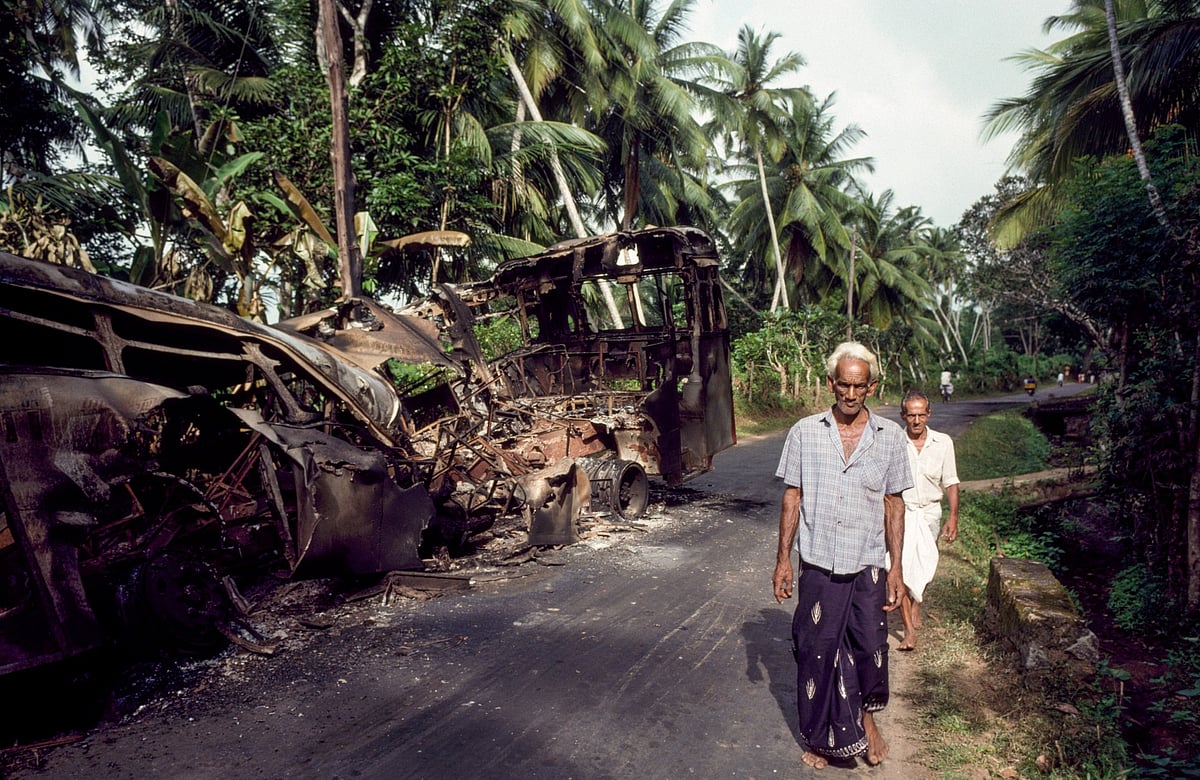
Militant Tamil nationalists were not the first to mount an armed insurrection against the Sri Lankan state. That ambiguous distinction belongs to the Janatha Vimukthi Peramuna, or People's Liberation Front – hereafter the JVP. The JVP was started in the 1960s, when several prominent members from the youth federation of the Ceylon Communist Party (Peking Wing) split from the main organisation over an ideological disagreement. Nagalingam Shanmugathasan, then the head of the party, believed that the mostly Dalit "Indian" Tamils in the Sri Lankan hill country, brought over as indentured labourers in the 19th and 20th centuries to build up the island's plantation economy, ought to form the vanguard of the revolution. The JVP leader Rohana Wijeweera, as well as his comrades, viewed these Tamils – distinct from the Eelam Tamils native to Sri Lanka's North and East – as agents of Indian capitalist expansion, and wanted the revolution for the Sinhala Buddhist peasantry.
In the words of the bibliographer H A I Goonetileke, the movement found its base among "an extremely left-oriented nativist militant cross-section of under-privileged rural youth in the upper forms of secondary schools, a minor army of disgruntled and largely jobless school-leavers, plus a sprinkling of university graduates and undergraduates from the forgotten backwoods of Ceylon." Their malaise was the malaise of Sri Lanka today – a failing economy, a corrupt political elite, a stagnant caste order – and their complaint directed at the same political order.
Around twenty thousand young men and women entrusted themselves to an elite leadership improvising a rebellion. On 5 April 1971, militias whose main weapon was the hand bomb attacked over seventy police stations all over the country, encroaching furiously on the South and Central Provinces, setting up camps in "liberated" villages and raising their red flag. The attacks even reached as far as the northern city of Jaffna, where Wijeweera was at the time imprisoned. From the report of a commission of inquiry set up afterwards to ascertain the facts of the insurgency, one discerns a rebellion made up of a great many small and independent mutinies, whose larger orchestration was offset by breakdowns in communication. Plans to seize Colombo and kidnap or kill the prime minister, for instance, fell flat due to scant and contradictory commands. Nevertheless, where the insurgents were strong in number and could retreat into the jungle, as in the central district of Kegalle, it took a state caught unprepared and low on ammunition (emergency arms supplies had to be solicited from the Soviet Union, the United States, Britain, India and Pakistan) nearly a year to put them down.
Insurgent deaths were estimated at between four and ten thousand, and over ten thousand were incarcerated. The rebellion sparked waves of unrest and reorganisation in Sri Lanka's universities, inspired malcontent Tamil youth in the North to form their own armed groups, and set in motion the since continual and exponential expansion of the Sri Lankan army into the budget-hogging beast it is today. The shock was felt in Sri Lankan letters too, where the insurgency forced an anglophone elite otherwise content to paint local colour with strokes of Modernism and brushings of Surrealism to turn towards the political, and invited them to an unsparing interrogation of themselves as the insurrection's target.