
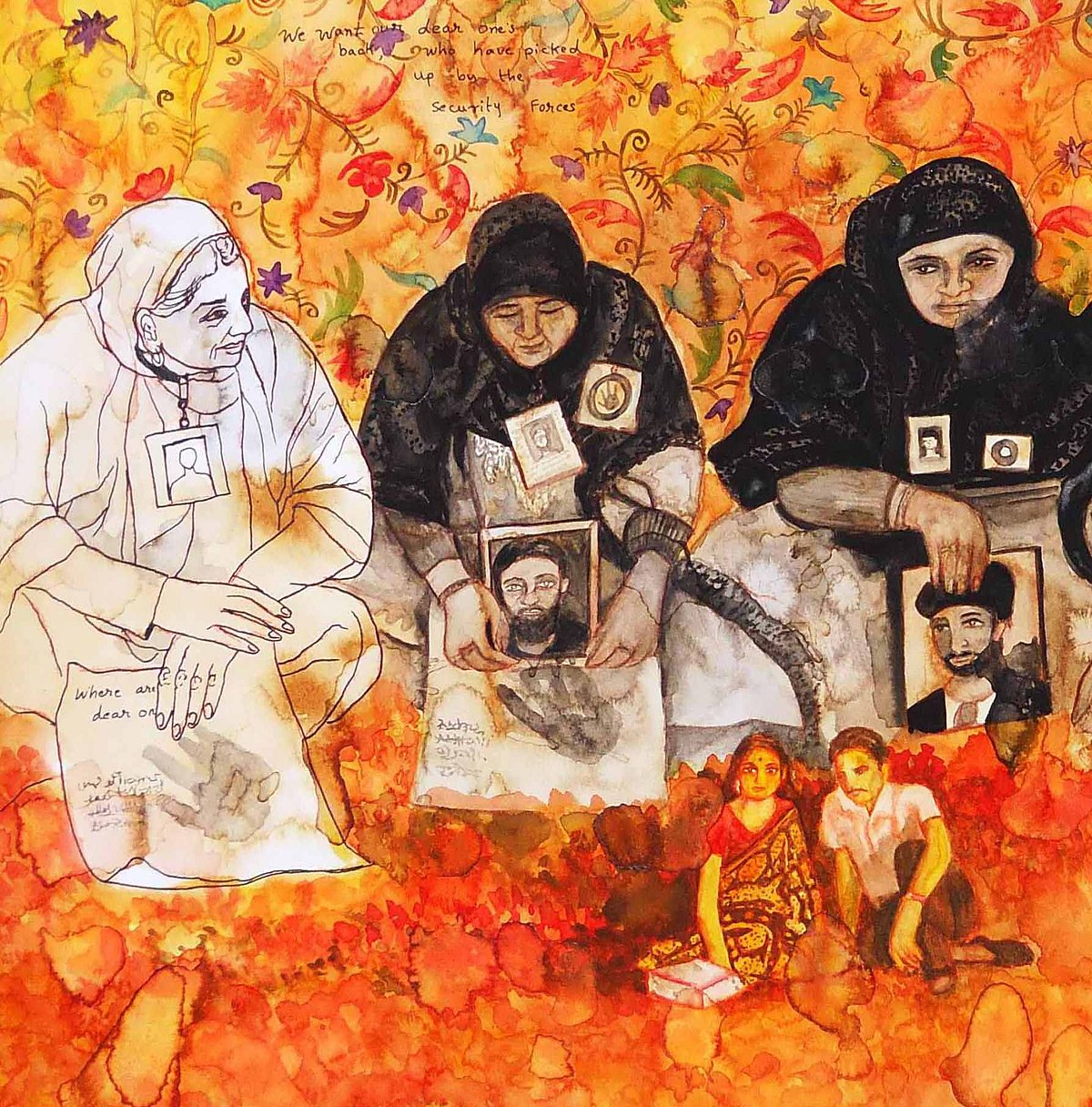
In Koshur – the Kashmiri language – the metaphors of pain invoke sky, earth, mountains, fire, sounds, textures, smells, colours, erasure, departure, and objects like knife, axe, saw, nails. Artist Rollie Mukherjee's work is a home to these metaphors. Through her paintings she evokes the geography, the body, the edifices of pain. Her work is not only pain in translation but the body in pain itself. Pain exists as a paradox: it is ephemeral yet it renders everything else insignificant. It is irretrievable yet it leaves a trace. But like pain itself, its trace is equally enigmatic. It finds a home in memory even though, as scientists now debate, memory itself doesn't have a home. The question is do we enter the sovereign territory of pain or is it the pain that enters us? If the latter is true, then isn't the familiar expression I am in pain, a betrayal of our sensorial experience, the pain is in me? In Koshur, pain is borne or possessed as is observable in the expression mei cha dagh (a literal rough translation would be: "I have pain"), or dagh lalnawaan (cradling/bearing the ache or pain). Pain asserts its sovereignty over the body but simultaneously evokes a longing in the body, for freedom. It may appear otherwise but a body in pain is undeniably alive; pain is a sign of life.
Mukherjee's work gives way to these transactions, conversations, interactions and relationships between body, longing, language and pain.
Frida Kahlo – the woman in pain, throughout her life painted intense self-portraits, which carried with them "the message of pain". The self-portraits of her body in pain became rivers which let her navigate through her wounds as she battled the effects of pain and painkillers. In 1925, Kahlo and her friend were in a bus in Mexico City when an electric trolley car rammed into it. She transgressed, possibly, all thresholds of pain. A metal handrail pierced through her body. The accident dislodged her shoulder permanently, left her spine, pelvis and ribs broken, and, her leg suffered multiple fractures.
Her clothes shredded, she lay there bare, her body scarred, disfigured, in blood and wreckage. But covered with gold dust. A housepainter onboard was carrying powdered gold which spilled over her. She lay there broken, in pain and gold. In his introduction to The Diary of Frida Kahlo, Carlos Fuentes describes this as a terrible and beautiful portrait. In Mukherjee's paintings, Kashmir is this body in pain – fractured and wounded, but covered in the gold dust of her imagination. Her work renders Kashmir beautiful because unlike the state's perverse imagination, she doesn't conceal its fractures and wounds but lays them bare.