
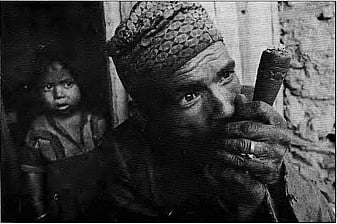
In northwest Nepal lives a group that is economically backward, socially oppressed, and psychologically pressured. The Khas of Jumla are a group that fell through the cracks of history.
You wouldn't know it when you meet them today, but the Khas people of Jumla District are descendants of proud rulers of an empire that once stretched all the way from here to Kashmir, and from the Tibetan plateau to the inner tarai. The Khas are the progenitors of the Thakuri-Chhetri and of some of the hill Bahuns who traveled eastward to conquer the lands that would ultimately form the Kingdom on Nepal. The Nepali language, once known as Khas-kura, owes its origin to them, and the Khas also lent their style of adopting Thakuri and Chhetri titles to other ethnic groups of the Nepali hills.
As an anthropologist who has studied and written about the people of Nepal for four decades, I have over the past three years been doing 'applied research' amongst these Khas of Jumla. My work proceeds under the umbrella of the Karnali Institute, based in the Chaudabisa Valley, whose efforts have been geared to applying the theories of the social sciences and development studies to raise the social and economic conditions of the Khas community.
Despite the accomplished past with which they are associated, this once-proud people today survive as a docile and unaware class relegated to an undeveloped corner of the country, exploited by those who know better, and burdened by an identity crisis that is unique in all Nepal.