
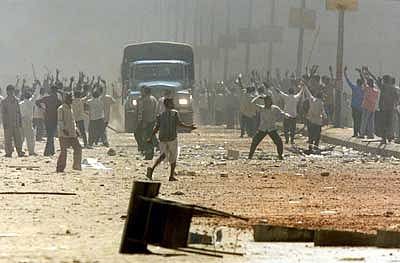
Growing up in Kashmir in the early 1990s, I was conscious of the state-sponsored rapes, disappearances and killing of unarmed civilians. There were no tribunals or mechanisms that could deliver justice to the victims of violence – each case only beaded into the more complex structure of violence and impunity. This pattern of impunity continues and exposes India's fractured justice system.
In her recent book, Gujarat Files: Anatomy of a cover up, journalist Rana Ayyub narrates a similar story of lawlessness – of "killing with impunity". The spine-chilling investigative account gives credence to the voice of many: for the first time, people in position of power during the 2002 Gujarat riots, and a series of murky murders that followed, have opened up about their role. Embedded in Ayyub's investigative account, these characters confirm what some activists and journalists have repeatedly said since 2002.
Identity is a prominent theme of Gujarat Files. Though she may not have consciously built up her narrative around it, the reader will nonetheless find it playing a major role. Ayyub intricately weaves the story of Gujarat around the persistence of caste exploitation and communal polarisation. The government of Gujarat at the time was engulfed in sanguinary politics, pitting one group against the other. The state machinery was used to create the narrative of a threatening "common enemy", the Muslim 'Other'. The language, Ayyub says, was one of hatred, and a public imagination of Muslims as "invaders", "sons of Babur – the invader", and the more threatening one of a "terrorist" was actively constructed. This role played by the state institutions – political and bureaucratic – in building up the anti-Muslim narrative was indispensible in making the 2002 riots possible.
The task of investigation and collecting the facts to put this book together was challenging. "I was a lone soldier on the field. I had to look after myself and ensure that the investigation yielded honest, fact-based results," Ayyub writes. With no takers in the publishing world, she struggled but eventually decided to self-publish the harrowing narrative of her experience in Gujarat. In the preface of the book, she mentions something a former editor said, which stayed with her: "A good journalist should learn the art of detaching herself from a story and be pragmatic." About this Ayyub writes, "Till this day, 'I regret being unable to master this art.' But it is this 'regret' that has led her to bring forth the truth of Gujarat, including the fake encounter of an alleged Lashkar-e-Taiba (LeT) 'terrorist' Ishrat Jahan in 2004 and the staged killing of Sohrabuddin Sheikh in November 2005. Very often, Ayyub adds, this advice of being a good journalist "is an excuse to kill a story at the behest of corporate and political powers." She shunned the advice, gathered herself, and undertook her peregrination. This account about her mission does not disappoint. The reader gets a sense of Rana's discomfort, but we also come across the courage which led her to embark on a journey in pursuit of truth. In the end, the author was left with only one option – "to go undercover".