
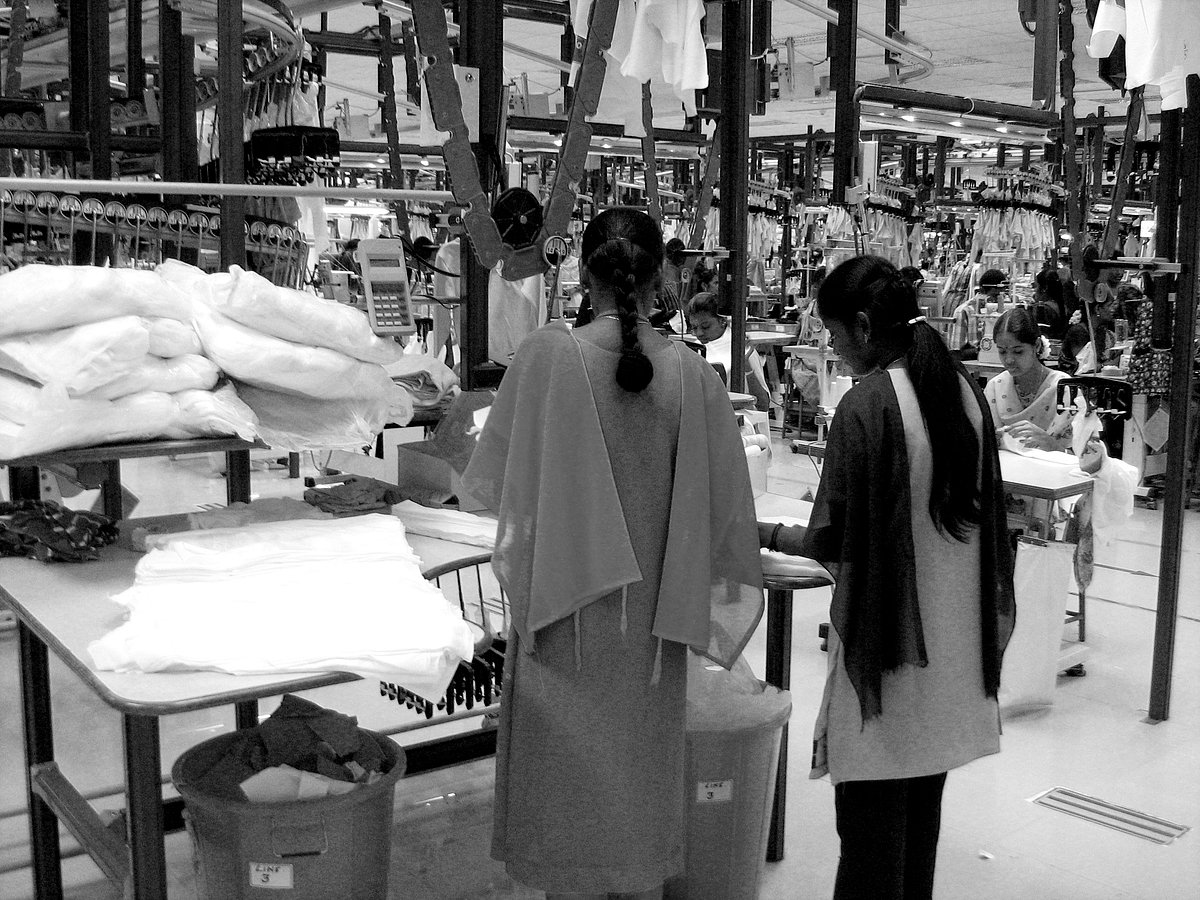
Every morning, dozens of buses arrive with relentless regularity at the high security gates of the Netaji Apparel Park in Tirupur. This is a brand-new, spic-and-span Industrial Estate at the outer bounds of the old town. The buses come from all directions, having snaked their ways through miles of dusty village tracks, with the precise, measured tread of an army convoy ferrying soldiers to a remote war post. At their destination, their blaring klaxons temporarily silenced by the screaming wails of banshee sirens announcing the start of a work shift, they disgorge hundreds of villagers. These are mostly young women, who disappear into the large factory complexes behind imposing, fortified gates. At every gate, a visitor is liable to find a torn-off piece of cardboard carton inscribed with two prominent legends: 'Labour Wanted' and 'No Child Labour'. Both are telling in their own way. The people consumed by this giant apparatus will emerge in due course – some after eight hours, but the majority after 12, perhaps 16, hours – trooping back into their allotted buses, to be ferried back to their villages.
Welcome to Tirupur, Tamil Nadu, also known variously as Knit City, T-Shirt City and sometimes even Dollar City. This is perhaps the only urban area in India with negative unemployment, with more jobs than there are people. It is for this reason that factories here are forced to haul in their workforce from as far as 60 kilometres away. Over two decades, Tirupur's growth has been exponential, rising from annual export revenue of INR 750 million (USD 12 million) in 1987 to more than INR 110 billion (USD 1.75 billion) in 2007. In more ways than one, Tirupur has become the beacon of New India.
In a pioneering 2004 study of the town and its business triumph, Sharad Chari of the London School of Economics attributed Tirupur's success to what he calls "Gounder toil". The Gounders are a Tamil-speaking community of landowning peasants, whose cultural homestead is in the region of Kongunadu, in northwest Tamil Nadu. Referring to the local translation for 'toil', Chari uses the term ulaippu, which is distinct from the Tamil for 'work'. He notes that the Tirupur peasant was quick to adapt first to cotton farming during the 1920s, and before long there were several flourishing Gounder estates, or thottams, feeding the spinning mills of Coimbatore. The Gounder peasants also evolved an intricate system through which to work their thottams, using both unpaid family labour and indentured Dalit workers.