
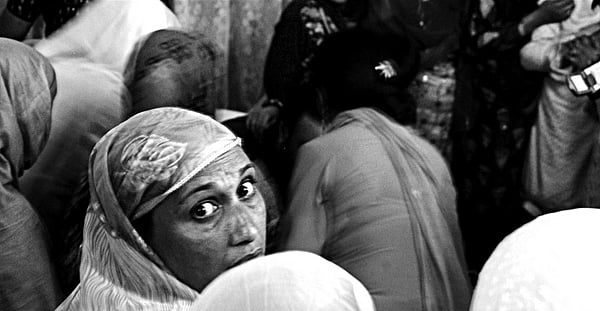
During a visit to Kashmir in June 2013, former Indian External Affairs Minister Salman Khurshid made a startling remark on the infamous Kunan-Poshpora incident. Referring to accusations of the mass rape and torture of Kashmiri villagers by the Indian Army on the intervening night of 23-24 February 1991, Khurshid told the media, "I am ashamed that [it] happened in my country." Khurshid's admission is ironic, not least because it is at total variance with the Indian state's persistent denial that Kunan-Poshpora ever happened. Twenty-three years have gone by, and five women waiting for justice have died. The case remains in a legal quagmire.
Kunan-Poshpora epitomises not only the Indian state's complete denial that gross human rights violations are being perpetrated by security forces in Kashmir, but, also, the Kafkaesque experience Kashmiris are subject to in seeking legal redress. Extra-ordinary legislation such as the Armed Forces (Jammu and Kashmir) Special Powers Act, for example, stipulates that the J & K government cannot prosecute armed forces personnel without sanction from the central ministries. Not only has no sanction ever been given, but there exists a sense of immunity so pervasive that even the normal procedures of criminal law, such as registering a First Information Report (FIR), initiating investigations, or filing a closure report before a magistrate, are routinely disregarded. The judicial system remains helpless as police and security personnel ignore standard procedures, flout court orders, prolong trials for decades on end and, often, do not even bother to appear in court.
The case of Kunan-Poshpora also illustrates how the Indian state scripts its own counter-narrative and employs the rhetoric of 'national security' to cast aspersions on the credibility and innocence of the victims of rights violations. The villagers of Kunan-Poshpora have told and retold their stories of rape and torture to human-rights activists, journalists, filmmakers and organisations such as Amnesty International and Human Rights Watch, none of whom have raised serious doubts concerning their veracity. Their macabre experiences have been imprinted on the collective memory of Kashmiris and often find expression in the region's art and literature. Young women say that 23 February is remembered as a Black Day. More recently, it has been marked Kashmiri Women's Resistance Day.
For the Indian state and B G Verghese, who headed the Press Council of India (PCI) commission at the behest of the Army and was instrumental in crafting an alternative, state-sanctioned narrative, the complaints of mass rapes are "probably a massive hoax". To this day, Verghese insists "it was an act of psy-war to keep the Army, newly inducted to deal with militant-jihadi-azadi uprising, at bay." According to the PCI report, the villagers' allegations are little more than a "tissue of lies". This is disingenuous: it is the state that nurtured deception, refusing as it did to properly disclose the status of the case.