
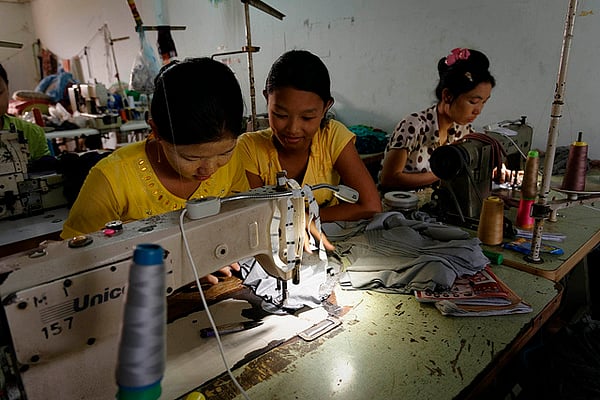
When General Ne Win seized power in Myanmar in 1962, the military (Tatmadaw) abolished all civil society associations, including labour unions, farmers' unions and student unions. The military state confiscated farmers' customary holdings, and despite officially propagating the 'Burmese Way to Socialism', erased labour rights along with the rule of law. As the country democratises, however, shop floors are becoming sites of contention: in May 2012 a strike spread across Yangon's industrial zones as Myanmarese workers demanded higher wages and better working conditions. For the first time in five decades, they could do so legally.
While the junta is now referred to as the 'previous government', the country's current leadership is only semi-elected as the military reserves one-fourth of the seats in Parliament. Billboards along the highways still proclaim the "Eternal Unity" of the people and the Tatmadaw. There have been important changes, though: pre-publication censorship was lifted in 2012 and Yangon University's central campus re-opened to undergraduates in December 2013. Importantly, in October 2011 Parliament passed the Labour Organisation Law (Pyidaungsa Hluttaw Law No. 7/2011) which came into force in 2012. The legislation allowed for the formation of 'Basic Labour Organisations' (BLOs) at the factory level and upheld their right to strike, while a follow-up law in 2012 created arbitration bodies to settle labour disputes. These laws replaced the colonial-era Trade Union Act of 1926 and abolished General Ne Win's 1964 'Law Defining the Fundamental Rights and Responsibilities of the Peoples' Workers'.
Having a right on paper is not, of course, the same as exercising it in practice. Workers have complained to local media that they risk redundancy for organising collectively. Moreover, though labour organisations in Myanmar could, in future, play an important role in enforcing pro-labour legislation, they are now hampered by splits among competing associations that aim to connect the newly-formed groups. As unions struggle to merge, Myanmar's manufacturing sector is already open for global sourcing and is becoming increasingly exposed to international competition. Rich in natural resources as well as cheap labour, the country is already being referred to as the 'ultimate frontier market'. A 2013 report by global consulting firm McKinsey & Company predicts that "Myanmar could conceivably quadruple the size of its economy, from $45 billion in 2010 to more than $200 billion in 2030 – creating upward of ten million non-agricultural jobs in the process". Myanmar would, however, need to more than double labour productivity to achieve these figures.
But what would productivity look like in practice? For the most part, Myanmar's garment sector uses outdated equipment and management practices, but has also had to adapt to survive years of Western economic isolation, when many companies folded. Taking orders primarily from Japanese, Korean and Chinese companies, many factories in Myanmar produce pieces of higher quality and complexity than their often-dilapidated appearances would suggest. One of the more modern factories in Yangon's Hlaingtharya Industrial Zone uses a flag system on the factory floor in an attempt to increase productivity – green above the worker's chair if the previous day's target was surpassed, yellow if it was met, red if it was missed. A mid-level female manager supervises as the flags wave above the young women operating the machines and the men stand ironing, in rows marked with shame or success.