
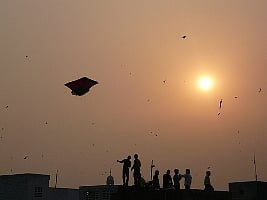
People have flown kites for millennia – for relaxation, as recreation, as an ancient tool for military signalling and as a modern signifier of an ephemeral harmony. The practice originated in China around 3000 years ago, from where it eventually trickled into South and Southeast Asia. In Pakistan, kite flying has long brought the followers of various religions together annually, to join hands – and cross strings – in heralding the arrival of spring.
In the Subcontinent, legend tells of the 12th-century saint Nizamuddin Aulia, of Delhi, and his grief at the death of his nephew, Taquiddin Nooh. As he was wondering what he could do to cheer him up, Nizamuddin's close friend and disciple, Amir Khusro, came upon a group of village women dressed in bright yellow, the colour of mustard in bloom. The women told Khusro that they were celebrating spring, and offering flowers to their gods. The sight of the gaily-dressed women did indeed brighten Nizamuddin's spirits, and to this day, the Basant, or spring, festival is commemorated with a profusion of mustard flowers at several Nizamuddin shrines. While they are celebrated throughout Southasia by communities of all religious backgrounds, the festivities have long had a particular connection with Lahore. And the old, walled city is especially famed for its enthusiasm for Basant patang baazi, or kite flying.
Lahore, once renowned for its fashion and style, has in recent years been working to recover the glory that it had as the cultural capital of Punjab. The effort began around 1990, when the World Bank funded a massive renovation of the old city. During this push, civic leaders latched on to the popularity of the Basant festival; and over the past decade and a half, Basant has become an event surrounded by so much hype in Lahore that many people have dramatically reworked their havelis (mansions) in the city, decorating rooftops and expanding lawns so as to be able to accommodate the festival-goers. Multinational companies have also cashed in on the public mood, and the festival has become increasingly commercialised.
Amidst this rising popularity, however, there is also rising angst. In recent years there has been growing public disgruntlement with the kite flying at the festival, due both to safety concerns and rising pressure from fundamentalist groups. A nearly year-round ban on flying kites throughout Pakistan, with a two-day exception for Basant, has now led to uncertainty with regards to the future of the festival. Indeed, the substitution in the public rhetoric of the Basant celebrations in general for kite flying in particular goes to show just how characteristic kites are of the Lahore festivities.