
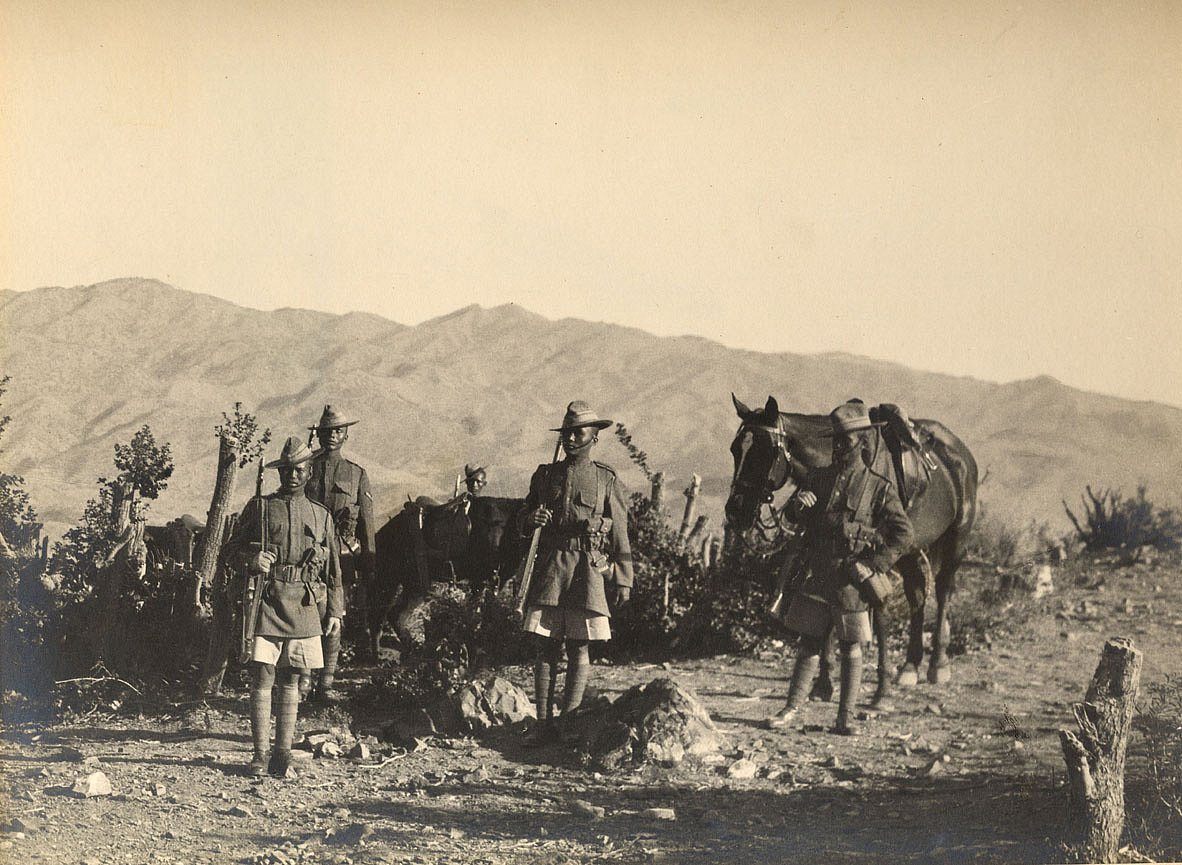
By the time I met my grandfather for the first and only other time, in 2000, his mental abilities were fast deteriorating. More often than not, he did not know where he was. He could not hear very well and he peed wherever he wanted. Yet, every now and then, he would regain his senses and peer at me and my sister with his one good eye and exclaim, "Oh, my granddaughters, my son's daughters." Then, within a few minutes, he would be sucked into his memories. One in particular stuck out: from the years he spent as a British army man in Malaysia – in the 1950s and 1960s, a time so far in the past, that his recounting entertained those watching him. But to him, he was a young soldier, standing once more in front of his commanding officer. He would recite over and over again, his rank, his name and his service number: Sergeant Nim Bahadur Pun. Service Number: 21134376. Sergeant Nim Bahadur Pun. Service Number: 21134376…
Aage aage topaiko gola
pachhi pachhi machine gun barara
cigarette nadeu ma bidi khanelai
maya nadeu ma hidi janelai
(Cannon balls in front me
Machine gunfire behind me
Don't give me a cigarette – I am a bidi smoker
Don't give your love to me – I am someone who leaves)
My grandfather had retired for almost a decade when Danny Denzongpa and Asha Bhosle sang this duet in the mid-1970s. But the song helps me think of my grandfather as a young, jocular, brave, flirtatious young man he might have been. Most 'happy' songs about lahures are similar. They portray 'lahures', a term that initially described Nepali soldiers serving in foreign armies, as the 'lucky' ones, characterised by bravery. These songs downplay the horrors of war and violence with an apparent insouciance that combines cannon fire with cigarettes; in the voice of soldiers who accept the reality that love might not be for them since they could be here dancing and singing today, and a casualty in a war tomorrow.