
I'm walking across the biggest landslide I've ever seen, and I know how I'm supposed to be feeling. But I don't feel like I'm stepping over the remains of hundreds of people, animals, and houses, buried deep under tonnes of stone. Instead, I'm experiencing something of an emotional white-out, a sense that I'm traversing a dead, empty space. The mountain responsible for the devastation just stands there, impassively peering over the grey, scoured rock that makes up the northern flank of the valley, as if it had nothing to do with the scene before me, nor the thousands of trees flattened like so many matchsticks on the south side.
Until last spring, this was the penultimate stop on a much-loved trek across Nepal's first Himalayan national park. Langtang Village was a thriving community, a genuine yak-herding and farming settlement that had taken to tourism with aplomb, and on the eve of 25 April, hundreds from up and down the valley had gathered at the monastery for a funerary ghewa for an elder. Many were caught in the monstrous landslide triggered by the 7.8 magnitude earthquake the next morning – if you can characterise a landslide as the cataclysmic brew of snow, ice and rock that buried over 70 houses and created a pressure wave that blasted anything in its path clean across the valley. Over 300 died in the Langtang Valley, and a third of the bodies were never recovered. In the aftermath, I worked on an oral history of the disaster, mostly by interviewing survivors at the Yellow Gomba refugee camp in Kathmandu, but was unable to secure a chopper ride into the valley. Well, here I was now.
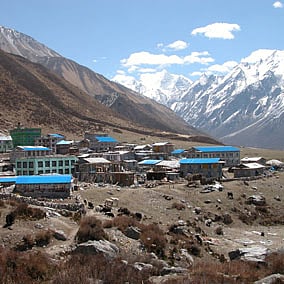
The lunar landscape is unrecognisable from the pastoral scenes I'd admired three years ago. But it is mostly in the approach to the site that the flotsam of lives gone – a battered dekchi here, a pair of slippers there, a collapsed kitchen crisscrossed with timber – weighs hard on one. A local woman, solar panel strapped to her backpack, overtakes me. She's singing, and beautifully, but I can't make out whether it is a song for the lost souls or a signal to jam out the "things that play on your mind" across this cursed terrain, as someone has told me down in Lama Hotel. Pausing frequently to take photos, I turn a corner to see her but a speck in the distance, moving quickly towards the upper end of the village, where a stone-flagged path emerges from the rubble and winds between sites now busy with masons. Here, witnessing the first signs of reconstruction, optimism supplants sorrow.
Also read: How one village forged its own recovery after Nepal’s 2015 earthquake