
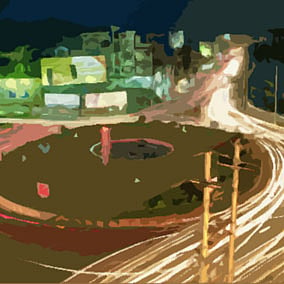
"Lokhora! Lokhora!" shouted a lean fellow, announcing the destination, in a sleeveless banyan that has become a dirty grey from its earlier white colour. Like a ballet dancer he flung open the back door, leapt on to the foothold at the same time, and balanced himself gracefully as he stood there keeping the door ajar with one hand. Three people got off, stooping to avoid hitting their heads on the ceiling of the Tracker, and another three standing on the pavement stepped in. There were already four passengers sitting in the row behind the driver. And three were squeezed in the front seat alongside the driver such that when he changed gears, he roughly brushed his fist against the knee of the passenger sitting next to him. Women, therefore, generally avoided sitting in the front row.
"Oi! Move from there!" cried out Brojen Barua agitatedly from the netted verandah of the house. "How many times should I tell you guys not to park yourselves here!"
The people in the Tracker didn't see him, but the driver started the engine and sped away. Brojen Barua was getting tired of these Trackers that had converted the spot right outside his gates into a stop. This had happened in the last two years or so with these vehicles almost taking over public transport in Guwahati. They were now seen in every nook and cranny, covering parts of the city where no buses go. "Who gave you the permission to make this a stop?" he often barked at them. And they ignored him, looking at him as if to say, do you own the road?
After the Tracker left, it was not even ten minutes when another showed up. Brojen Barua, nursing a perpetual strain because of his stiff neck, thought better not to waste his voice. It was nine in the morning and it was not just the Trackers that were disturbing him but the grunts and growls of the vehicles that plied by incessantly. There seemed not a moment of respite from the cacophony. And Brojen Barua wistfully rolled his eyes, as he always did when the irony of changing times flitted through his thoughts. This lane had been named after Bishnu Rabha, kala guru, a much beloved cultural icon of the Assamese people, who left behind a legacy of musical compositions decades ago. But with the rise of apartments over the years, the lane had come to be home to many migrants from outside Assam. Especially for those from Bihar, Uttar Pradesh and Punjab who have been lured into Guwahati by the coal trade in Basistha. And for them, Bishnu Rabha held no meaning. It was just a name on the signboard at the mouth of the lane in Beltola Tiniali. And with time, as the density of these high rise apartments and population increased, this lane came to be known simply as Bhetapara Road because it led to the newly developed Bhetapara area and beyond. As people forgot it as the kala guru Bishnu Rabha lane, it began to generate a different kind of music night and day. This was created by the continuous rush of vehicles, robbing the peace of the people in the neighbourhood. And residents like Brojen Barua, who had been here for more than 20 years, longed for the old days when this side of the city was the outskirts and when quietude still defined its character.