
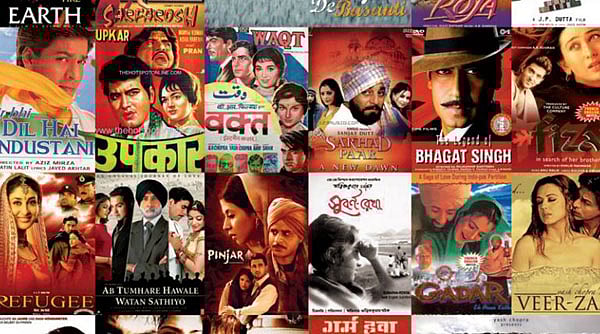
Borders and boundaries, hitherto confined as categories of analysis to the study of political geography, are now objects of interest within several academic disciplines, including anthropology, history, political science, social psychology and sociology. While borders activate notions of difference between peoples and places, every year millions of people worldwide breach these borders, both officially and unofficially, in contexts of peace, conflict and violence. In Meenakshi Bharat and Nirmal Kumar's edited volume Filming the Line of Control: the Indo-Pak relationship through the cinematic lens, political cartography and its psychological impact is the central category of filmic analysis. As the title suggests, the book studies the ways in which the Line of Control (LoC) is constructed and represented in films – the first time this theme has been examined by those studying popular cinema. For this groundbreaking focus, the editors and contributors to this volume deserve praise.
Divide and rule
Borders and boundaries have been a source of contention for countries and communities across the world since the rise of the nation state. Borders define a country's territory, and in so doing, also define an 'Other'. More often than not, borders are drawn and redrawn arbitrarily, and while they are intended to be sacrosanct, they are invariably transgressed. To maintain the sanctity of its borders, nation states spend huge amounts on the forces that guard them. Julian Minghi, one of the first theorists of borders and boundaries, calls them the most political of all geographical phenomena. Though in the 1960s, academic studies restricted themselves to examining the demarcation of territory between countries, contemporary approaches emphasise the importance of borders and boundaries in the study of ethnicities, cultures and societies.
Bharat and Kumar's edited volume is a collection of essays – ranging from simplistic textual analysis to insightful, in-depth readings – by scholars of repute in their respective fields that seeks to build on this broader academic trajectory. It is divided thematically into four sections, namely, 'Negotiating the Border', 'Drawn Lines', 'Rapprochement', and 'Interviews', and closes with a filmography and bibliography. The book traces the trajectory of Indo-Pak relations through readings of popular films (most of those studied are from Hindi cinema, but more on that later), operating under the assumption that these reflect Indo-Pak relations, and may be used as epistemological tools to understand political geography and the concept of nationhood. Apart from one essay by Kamayani Kaushiva on the creative output of Ritwik Ghatak, and one by Aparna Sharma on 'Crossing the Line of Control through the Documentary lens', the book neither deals with regional language nor non-fiction films.
THE SOUTHASIAN MILITARY COMPLEX:
WEB-EXCLUSIVE PACKAGE Where is Sodi Shambo? by Sharmila Purkayastha