
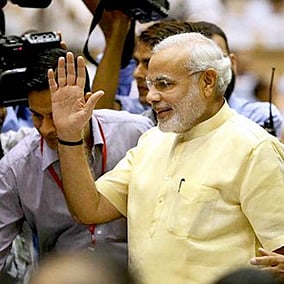
In summarising India's 2014 General Elections, the media pundits have proclaimed a breathless flurry of firsts. Among the more substantial of the contentions is the unprecedented role of the breathless pronouncers themselves. Struck by the saturation of images of Narendra Modi (India's new Prime Minister elect) during the election campaign, veteran journalists started asking questions very early on about the role played by the media in consolidating around him. As the results have become clearer, the conclusion that this election has marked a watershed in the extent of mediatisation of electoral politics in India is unavoidable. This enlarged role of the media is a momentous development, and certain to continue. It is also one with serious implications for the very nature of politics in India. In particular, for those of us who believe that democratic politics has a role to play in empowering progressive social transformation, there are difficult questions here worth confronting.
The 'Modi wave' accomplished nothing less than the transformation of a person marked by the stain of the worst communal violence in India for the last 25 years into a benign and acceptably authoritarian figure. The images and slogans streamed relentlessly: from the elevation of Gujarat to a utopic island of development, to publicity stunts like Modi's helicopter 'rescue' of Gujarati pilgrims stranded in Uttarakhand; from full front-page advertisements in newspapers, to the systematic propagation of the myth of Modi's 'clean chit' by the Supreme Court; from television interviews (where gently lobbed queries elicited careful and genteel replies) to wall-to-wall coverage of Modi, addressing (through holograms, when not in person) heaving crowds at rallies and roadshows. Over the course of a year, Modi's persona as the firm, efficient, patriotic and misunderstood man that India awaited was co-crafted by PR agencies and primetime anchors. For the first time, the campaign was also carried online. While substantially less important than television, a visible presence on social media – Twitter, Facebook and even mobile phone apps – appears to have become essential for major political players.
This effort, the most intense ever seen in India, to keep Modi in the public eye was sustained through staggering campaign expenditures. While estimates vary and are, in the last instance, unverifiable, the range of expenditure reported for the BJP is INR 500 crore to INR 5000 crore on advertising alone. The BJP, the party with the deepest pockets, is also estimated to account for two-thirds of the overall expenditure in these elections. This bought near-monopolistic television coverage. According to one estimate, 33 percent of primetime television coverage was devoted to Modi – over three times as much as the next highest coverage of any other personality, and eight times as much as that of Rahul Gandhi.
New communications and new constituencies
There are at least two reasons why it makes sense to claim that control of the media has only recently become a key element of a successful electoral strategy. Between 2001 and 2011, much of rural India threw out its transistor radios and replaced them with televisions. This was not simply an upgrading of a household amenity, but a vast expansion of the economy of images.