
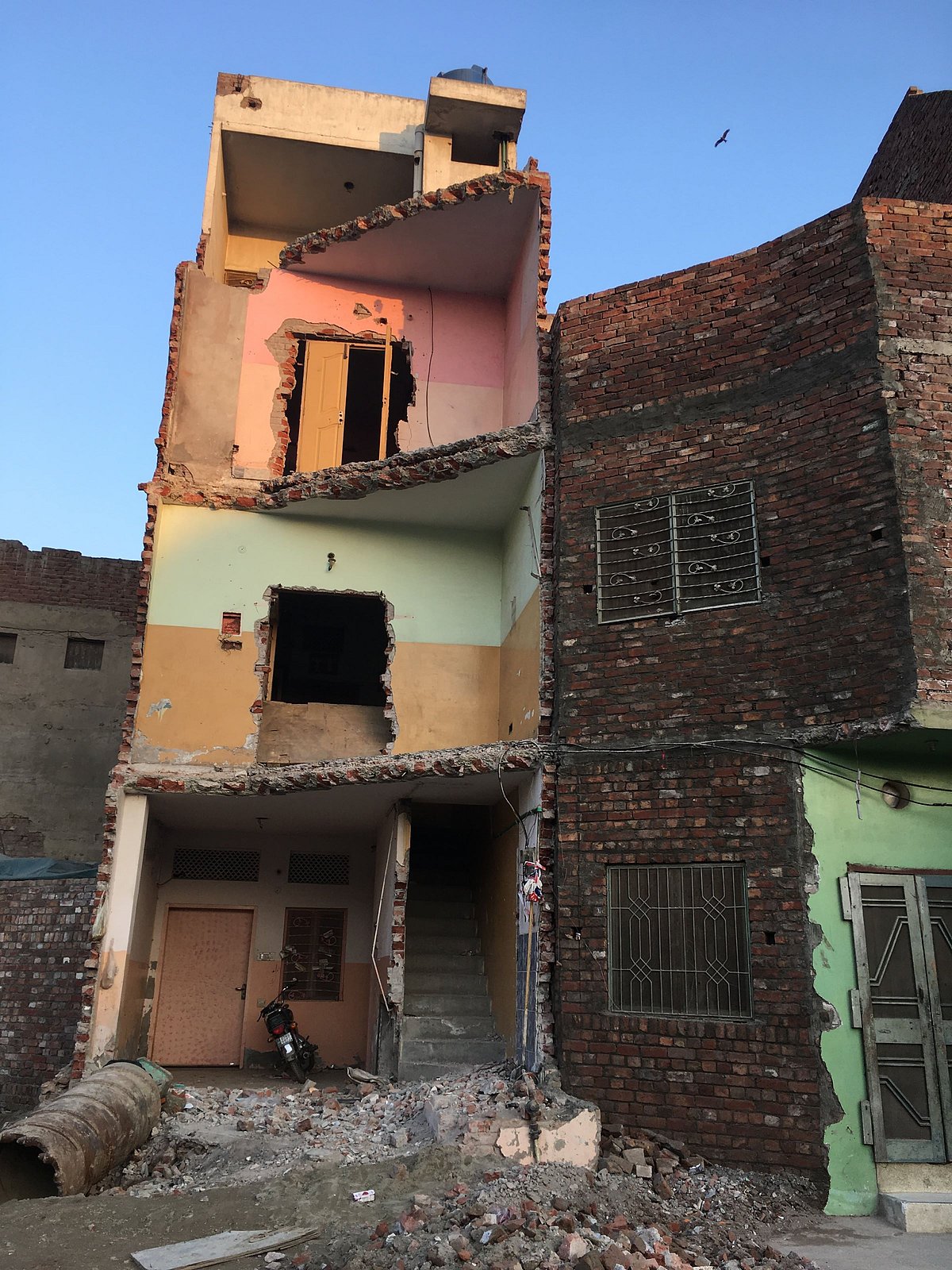
The Orange Line Metro Train Project – a 27-kilometre rapid transport line running through the heart of Lahore, being built at an estimated cost of USD 1.6 billion – is still to be completed. As one of eight mass transit lines proposed for the rapidly expanding city of over 11 million people, the project aims to improve public transport provision in the city, particularly as the existing network frequently suffers from overcrowding, delays and breakdowns. Due to a combination of the chosen route and the cut-and-cover technology used for construction, however, several residential and commercial areas have been affected. In one neighbourhood, residents, many of whom had lived there since Partition, only found out about the planned evictions when officials from Lahore Development Authority placed a mark on their doors and later demanded that they vacate their homes. The residents put up significant resistance but were, ultimately, evicted. While many were given some monetary compensation, several were left with no such recourse. Having lived together for generations, expanding and consolidating their housing over time, affected residents are now living in different neighbourhoods across the city. While some have been able to purchase their own homes, others have been forced to become renters, or have had to move in with extended family. Many have moved to neighbourhoods as much as 5 to 8 km away from their original place of residence, no longer able to rely on social networks formed over three generations.
Following the end of Sri Lanka's three-decade civil war in 2009, the government, under President Mahinda Rajapaksa, envisioned transforming Colombo into a 'world-class capital city'. From 2013 onwards, under the 'Urban Regeneration Project', this resulted in the relocation of a significant proportion of working-class communities who were occupying what was deemed to be 'prime commercial property', but living in what was described by the Government as 'slums and shanties', or later 'underserved settlements'. A majority of the communities, however, had been allocated land or housing by the state under its various housing policies, or at the very least had a 'green card' from Colombo Municipal Council recognising their residence. They lived in permanent, well-built houses in which their families had invested and which they had built incrementally over time. As in Lahore, many of the families had been living in their communities for generations. Many had title deeds or government issued ownership cards. Regardless, most of the communities were given 1 to 3 months' notice before their homes were demolished, and families relocated to state-built tower blocks located on the outer periphery of northern Colombo. From 2010 to 2014, the Urban Development Authority (UDA), the implementation agency of the Urban Regeneration Project, functioned under the newly created Ministry of Defence and Urban Development. During this period, many of the relocations and forced evictions took place following harassment and threats by military personnel, when communities resisted the move to the high-rises. Relocated communities were not compensated for their homes even if they held title deeds, and instead had to make a down payment of LKR 25,000 to LKR 100,000 and eventually LKR 1,000,000 over a period of 20 to 30 years in order to get a deed to their flat. By 'liberating' the 'underutilised' land that these communities occupied in the heart of the city, the state under then President Rajapaksa's regime as well as the subsequent Maithripala Sirisena government, were able to hand this property over to local and foreign investors to build luxury high-rise condominiums and mixed development projects.
Property ownership, with its decidedly bourgeois roots, appears as a middle-class phenomenon. Yet, as we conducted fieldwork on housing among a range of aspiring and working-class communities in Colombo and Lahore, we found that the longing for a place to call home is present across Southasia, and in all demographics. Nowhere does this become more obvious than when the right to this cherished ideal comes under threat, as it did for our interlocutors who were evicted and relocated from their homes due to state-led infrastructure projects. Their experiences and articulations of loss bear witness that, as the scholar-activist Gautam Bhan often reminds us, housing is not just about houses, but representative of and anchoring to life itself. In doing so, the home comes to stand for life, death, and all that occurs in between. At the heart of our essay is a concern with the politics of grieving, and what Judith Butler calls 'grievability' – that is to say, which populations and groups are allowed to grieve and, in turn, whether their loss is recognised as grievable by others. Within mainstream state and development discourses, the economic considerations of marginalised groups dominate in a way that often erases what it is that makes their existence a life.
Although our research largely focused on the impact of this dislocation in terms of destruction of kin support networks and resettlement patterns, our interviews also made us reflect on the fabric of life that had been destroyed. Lahore and Colombo are markedly different contexts, but in both places, people talked about the loss of their homes in relation to experiences and rites associated with life and death.