
In the courtyard of the Mural Art Museum in Thrissur, Kerala, I was staring at the tombstones lying around, scattered like garbage. The names on the granite slabs were strange, the images sculpted on them exotic and the script hard to decipher. A slab with a Jolly Roger-like skull and cross-bones belonged to Francisco Rodrigues, maybe a sea pirate; another to Mateus Arruda, a vicar; then Antonio Raposo and his heirs; elsewhere, someone from the Costa family; and, in a corner, Jorge Fernandes, who died on 22 December 1565.
Senior archaeologist S Hemachandran suggests that the stones were brought in from Kochi in the 1930s. Around 1925-26, Sir Robert Bristow, a harbour engineer who built the Kochi Port, recovered them from the seabed while dredging the harbour to create a deeper haven for ships. Kochi's placid backwaters had long provided a safe berth in tempestuous times for ships that came from all over the world in search of lucrative spices.
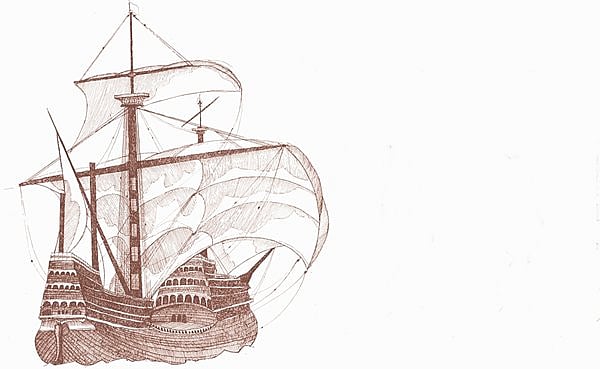
Following the footsteps of Vasco da Gama, Portuguese explorer Pedro Alvares Cabral had started his journey east with a fleet of ten ships, 1500 men and a fine collection of muskets and machetes. He arrived in Kochi in December of 1500. In very little time, the Portuguese established themselves as the biggest power on the west coast. When they first arrived, the town was small and humble. The houses were built with mud walls and the roofs thatched with leaves. Even the king sat on a mat made of grass. The Portuguese settled down, built forts and churches, married native women and fathered a mixed race they called mestiços.
The 163-year-long Portuguese rule only came to an end in January of 1663. A Dutch admiral, Rickloff van Goens, led a successful attack on his fellow Europeans. The Dutch had captured the island of Vypeen, north of the mainland, two years earlier. They proceeded inland. The bloody Dutch siege of Kochi lasted eight long days and nights. Admiral Goens set up his headquarters at the Portuguese Bishop's House. He proceeded to fortify the Roman Catholic Church to station his 700-strong force. When the town fell, the Portuguese left for Goa. One of the churches they left behind was converted into a warehouse, another into a Protestant church. Only one was left untouched for the Catholic folk. Bricks and stones from the destruction went into the construction of palaces, houses, and the Dutch fort of Neuw Oranje. The elaborately carved tombstones of Portuguese traders and sailors that once decorated the churchyards were thrown into the harbour, it is assumed.