
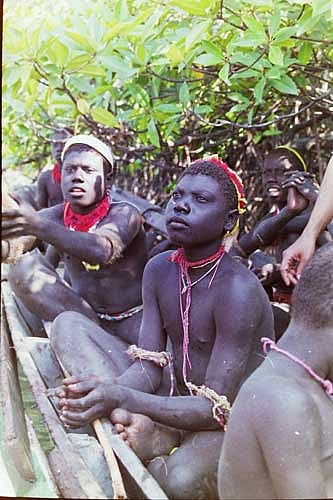
The Last Wave is a love story, or rather, two. One is a fairly conventional tale of growing attraction between a man and a woman, thrown together not only by circumstance – confined as they are on a dungi, a small boat, with their five-person team, exploring a pristine coastline – but also by their shared wonder and concern at all that they see and hear. The other is between a journalist and an archipelago. Pankaj Sekhsaria is in love with the Andaman and Nicobar Islands, and it shows – in the occasional but compelling lyricism of his writing, and in the reverence with which his characters circumnavigate the Jarawas' territory, probing its mysteries without quite violating its boundaries:
Since the 1990s, the author has devoted himself to defending all that is magical about the emerald isles, their coral-studded waters, and the ancient culture that thrives within its glorious and primeval rainforest. The novel is a first for Sekhsaria, who has several other identities – journalist, environmentalist, activist, photographer, and academic.
In each of these personas, however, he has served the islands and its peoples, and his turn as a novelist proves to be no exception. Sekhsaria has written magazine articles about the Andamans; campaigned to protect the Jarawa, the hunter-gatherers who live within the strip of great evergreen rainforest along the western coast of two Andaman islands; published academic articles on the archipelago's environment, development, and strategic role in India's defence policies; co-edited a collection of papers on the Jarawa's encounters with outsiders; and, most recently, exhibited photographs on the archipelago's natural wonders. He has annoyed many of the islands' mainstream residents by advocating that the road through the Jarawa territory be closed, because it brings in pernicious influences. And yet, when the December 2004 tsunami washed away thousands, and the administration dithered, it was the Yahoo webgroup – andamanicobar – which Sekhsaria initiated and still administers, that became crucial to disbursing information and coordinating aid efforts. So, while most writers would use the Andamans merely as an exotic setting for a story about humans, for Sekhsaria, the exquisite but fragile archipelago is the true protagonist. Through the eyes and ears of the novel's characters, we learn about the islands and its intriguing communities.
Seema is a 27-year-old "local born", descended from the first Indians who arrived on the islands in the late-19th and early-20th centuries. Her great-great-grandfather, a Muslim, had ended up in the penal colony of Port Blair, established in 1858 by the British, for beheading his sister's rapist; her great-great-grandmother, a Hindu, was a freedom fighter. In the Andamans, such interfaith unions were common. Seema has recently returned after studies on the mainland in order to research her own people, the local borns. Harish, a mainlander, is searching for the meaning of life after a disastrous marriage by touring the islands with a reporter friend. Uncle Pame, the elderly Karen boatman, is perhaps the most remarkable character in the book: he has witnessed the Jarawa slay his parents, but nonetheless believes they have a right to defend their forests from outsiders.