
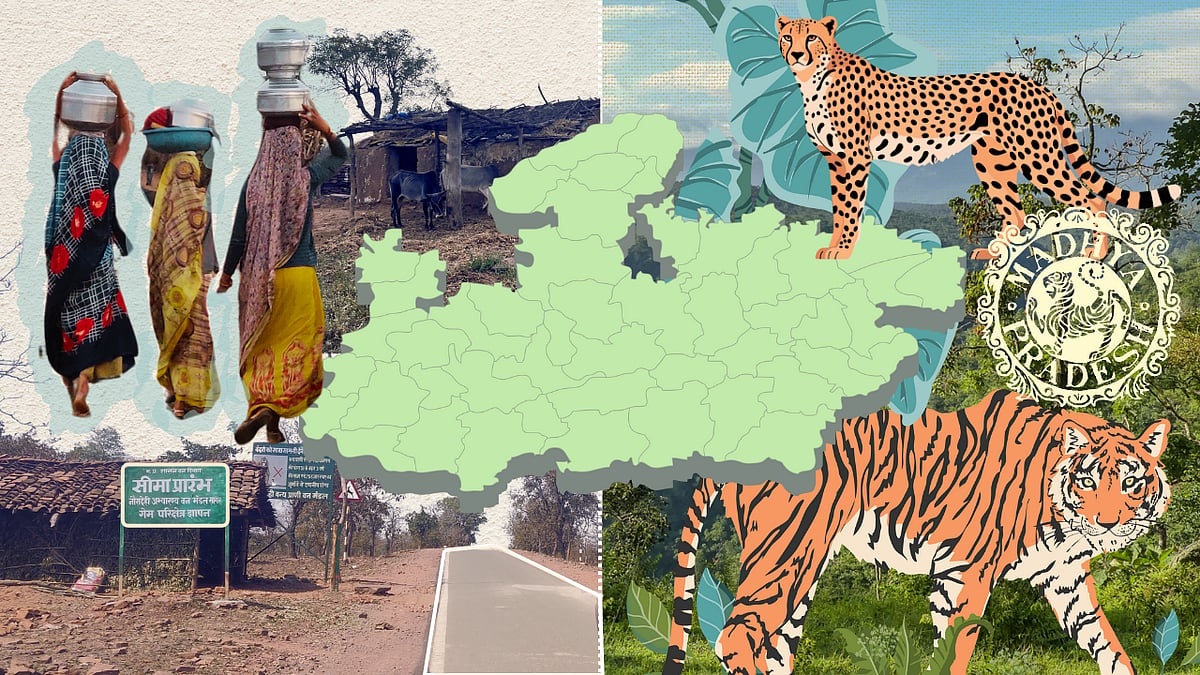
“WE NEVER WANTED to relocate, never consented either,” Dhani Singh Marvi, a resident of Ramkhiriya, told me when I visited his village in 2023. “But the forest department pestered us to go away, saying tigers and cheetahs were to live here.”
Ramkhiriya is a small village inside the Nauradehi forest, an area designated as a wildlife sanctuary in the Indian state of Madhya Pradesh. In 2010, it was one of three protected areas shortlisted by India’s central government as a possible site at which to reintroduce cheetahs in the country. The Madhya Pradesh forest department and the Wildlife Institute of India (WII) – an advisory body to the country’s environment ministry on matters of wildlife management and conservation – published an action plan in 2012 for the reintroduction of cheetahs in Nauradehi. It recommended relocating human settlements to create an area of 700 square kilometres within the wildlife sanctuary as a core habitat – an area described in India’s Wild Life (Protection) Act as an “inviolate space” for tigers. The plan proposed the immediate relocation of 21 villages and three settlements out of the total of 69 villages in this sanctuary.
The cheetahs never came to Nauradehi. Instead, in September 2023, the state government merged Nauradehi with another wildlife sanctuary, called Durgavati, to create the state’s seventh tiger reserve, the Veerangana Durgavati Tiger Reserve. Over the past decade, the state carried out massive forced relocations of villages and regulated their traditional use of forest resources in the name of big-cat conservation. The state government is now preparing to reintroduce cheetahs in this landscape, which could make it the first state-controlled conservation territory in India to house both tigers and cheetahs.
The Veerangana Durgavati Tiger Reserve is the largest tiger reserve in the state, stretching across the three districts of Damoh, Sagar and Narsinghpur. The area notified as its core spreads over a massive 1414 square kilometres. Of this, 21.3 square kilometres alone was made part of the core area by relocating villages as part of the cheetah reintroduction plan, before Veerangana Durgavati’s notification as a tiger reserve. The government plans to clear another 167 square kilometres for the core by relocating more villages. Ramkhiriya falls within this area and has been listed for relocation.