
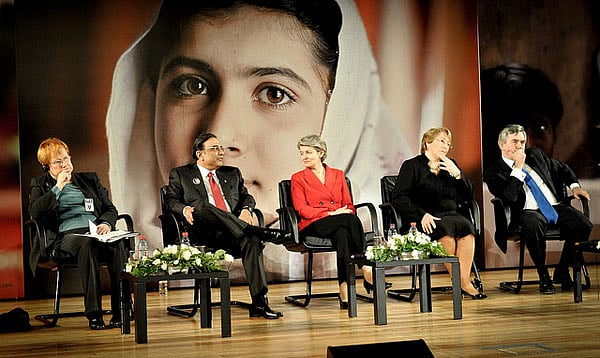
Before she became a world-renowned advocate for girls' education, before she became a victim of the Taliban's brutality, before she was nominated for international accolades, Malala Yousafzai was this: a scared little girl. The title of Malala's first entry in a diary she kept for the BBC in 2009 was 'I am afraid'. Over the course of ten weeks, the 11-year-old offered a glimpse into her life in Taliban-occupied Swat. Her accounts provide a picture of the very real threats she and her schoolmates faced for pursuing their studies, but do so with childlike simplicity. She describes, for instance, the day her teacher told the class not to wear uniforms to school for fear of being targeted by the Taliban. Malala came to class in her favourite pink dress. "Other girls in school were also wearing colourful dresses and the school presented a homely look," Malala wrote.
In order to protect herself from reprisals, she wrote under the pseudonym Gul Makai, a heroine of Pashtu folklore. Malala liked this fictitious byline because it allowed her to escape the ominous meaning of her own name: 'grief stricken'. Her pseudonym was given to her by Abdul Hai Kakar, a former BBC Urdu Service reporter. "I wanted to give an indigenous, symbolic attachment to Swat, so that the people could own [Malala's diary] journalistically," he explained. Kakar had first conceived the idea of a diary as a way to give "a humanitarian face to the tragedy" of Taliban occupation.
It's likely that Malala herself did not leap at the chance to be that humanitarian face. It was her father, Ziauddin Yousafzai, an activist and educator, who volunteered her name when Kakar approached to ask if he knew any girls who would be willing to write. "He said nobody was ready to talk because everyone was afraid of the Taliban," Kakar recounted in a recent interview. "But he hesitantly told [me] that if I agreed, then his daughter could work with me."
Ziauddin Yousafzai must have known that there were serious risks involved in letting his daughter document her educational pursuits in the Taliban-dominated region, but in this, an opportunity as well. One in which a young girl's life-threatening quest to obtain the basic right of education would reveal just how oppressive the Taliban in Swat had become. Through her diary entries, Malala described the very real threats the regime's extremism posed to her everyday life – and by doing so, she grew into a symbol of resistance. It didn't take long for the young girl to transform into an activist and someone whom Taliban recognised.