
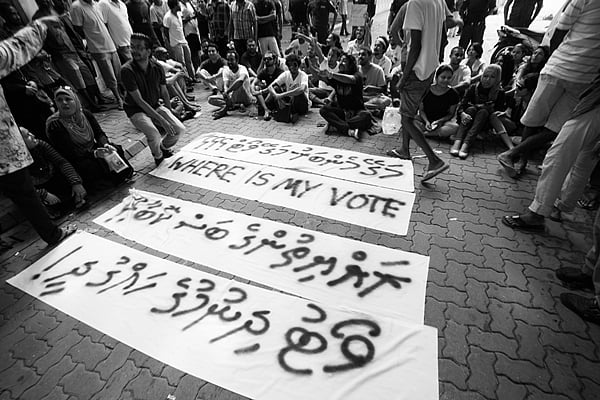
On 7 September 2013, 88 percent of the Maldivian electorate turned out to vote in the country's second ever democratic election. In the glorious Saturday sunshine, over 200,000 people headed to over 400 polling stations on over 200 islands scattered across the Indian Ocean to vote for one of four candidates. Hundreds of Maldivians did the same in Sri Lanka, India, Singapore, Malaysia, and the United Kingdom. Forty five percent of them voted for Mohamed Nasheed, the candidate for Maldivian Democratic Party (MDP); 25 percent voted for Abdulla Yameen, former ruler Maumoon Abdul Gayoom's half-brother and candidate for Progressive Party of Maldives (PPM); 24 percent voted for tourism tycoon Qasim Ibrahim, candidate for Jumhooree Party (JP); and 5 percent for incumbent Mohamed Waheed Hassan Manik. By all accounts, the election was an exemplary display of the democratic process at work – free, fair and transparent, with less errors and discrepancies than is the expected norm in any such election. This was the consensus of all domestic and international observers from far and near. Although Mohamed Nasheed won a clear majority, he fell short of the 50% plus one required for an all out win. With eager anticipation, people began counting down days for the run-off second round between Nasheed and Yameen, scheduled for 28 September 2013.
It did not happen. On 11 September, Qasim Ibrahim, the tourism tycoon with deep pockets, filed a case at the High Court alleging fraud and vote rigging in the first round. He wanted the Court to allow him, and all other candidates, to see the list of people who voted on 7 September. Before the High Court could rule [ultimately in JP's favour], Qasim filed a case at the Supreme Court, this time asking not just to rule the Voters Registry void, but also for an annulment of the first round. Qasim's Villa Foundation had made 'donations' worth hundreds of thousands of dollars to students, schools and other such institutions during his expensive campaign. Given the amount of money he spent, he believed he should have got a better result. In his reasoning: "when you subtract 20,000 [the fraudulent votes allegedly received by the MDP] from those 90,000 [of the votes gained by the MDP] I believe it is us who are in the lead."
Kafka in the Court
The three-week long Supreme Court trial was a Kafkaesque farce. It accepted the case based on little else but Qasim Ibrahim's belief that he should have got more votes. 'Evidence' came in the form of secret witnesses who were hidden from view. Only their disembodied voices could be heard, claiming that they knew of incidents where people who could not have been more than 18 years of age voted at particular polling stations, but against whom they could not provide any proof. For the Supreme Court, this was evidence that minors voted in the election. It stopped short of holding a séance to summon to court the dead people who allegedly voted in the election, but did admit as evidence a secret forensic report which was so secret that even the Elections Commission, as the defendant, was forbidden from seeing it. Although the Parliament requested a copy of the report this week, so far it remains a secret. Another secret reportcompiled by the same 'expert police forensics team' was leaked on the Internet shortly after the first election was annulled. It provides a good indication of the standard of proof contained in the report that the Supreme Court considered as 'evidence'.