
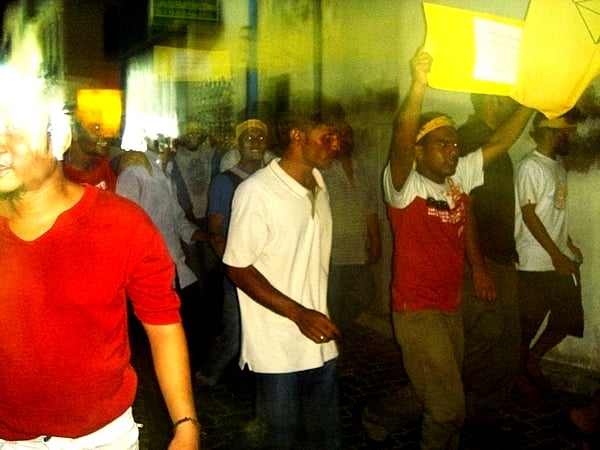
On 23 October 2019, a government-endorsed transitional-justice bill was tabled in the Maldivian parliament, the People's Majlis. The bill, which is currently at the committee stage, purports to redress systematic rights violations and torture in the Maldives. Yet the bill does not meet international standards. If the People's Majlis passes the bill into legislation in its current form, the Maldives risks depriving hundreds of citizens of their right to reparations for severe human-rights abuses involving state security forces.
In 2018, Ibrahim Mohamed Solih was voted in as president and given an overwhelming mandate to address past grievances and begin a process of national healing. A transitional-justice mechanism aligned with the Maldives' international obligations, and with long-term domestic political stability in mind, should address systematic and widespread attacks on civilians. As Desmond Tutu, the Chair of South Africa's Truth and Reconciliation Commission said in 2001: "Reconciliation means that those who have been on the underside of history must see there is a qualitative difference between repression and freedom." But the Maldivian government is now turning a blind eye to repeated calls by the UN's international human-rights mechanisms.
Falling short of international standards
Shortly after the Solih government assumed power, in November 2018, the UN Committee Against Torture reviewed the Maldives for the first time. The Committee applauded the new Maldivian government's plans to include transitional justice in its legislative agenda. However, it noted that the temporal jurisdiction of the transitional-justice bill, which restricted its scope to between 2012 and 2018, could deprive survivors of historic incidents of torture of remedy, as pre-2012 allegations made before 2012 that have yet to be effectively investigated.