
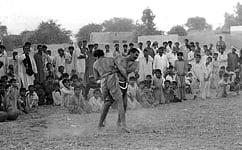
The word malh is derived from the Sindhi malha'n, meaning 'to celebrate'. Contemporary linguists have accepted the word as a proper noun describing the ancient Sindhi form of wrestling that is today also played in Balochistan, NWFP and Afghanistan. Malh is thought to date as far back as the Indus Valley Civilisation, and is said by some to have led to the internationally popular Greco-Roman form of wrestling.
Long before Pakistan became a separate country, malh was famous in Sindh, trumping other contact sports such as bilharo and wanjhavati. While all three were popular in the rural areas, British influence eventually led to cricket taking hold in the urban centres. After Partition, Pakistan's governments have displayed a tendency to mimic the colonisers, including in their support of certain games to the exclusion of others.
As such, the authorities in Islamabad have promoted hockey and football, and greatly pampered cricket players. Meanwhile, they have paid scant attention to the traditional games of Punjab, Sindh, NWFP and Balochistan, leading to the gradual decline of these pastimes. Bilharo and wanjhavati, for instance, are now virtually extinct in Sindh, while many worry that malh has been limited to being a traditional spectacle rather than as a popular sport. An exploration of these issues unpacks the story of the Sindhi nation, and of the suppression of its culture and aspirations.
Sandro Diann
Malh in Sindh is still played with traditional flair, with certain rituals performed before each game. The mood is set by Manghanhaar fakirs, Sindhi folk musicians, beating drums to a particular rhythm. Games generally begin in the evening, and the drumbeat serves to attract spectators. The fakirs are accompanied by a musician playing the shehnai, the reed instrument. The music they produce together is called malhkhri ji vajja, the music of the game.