
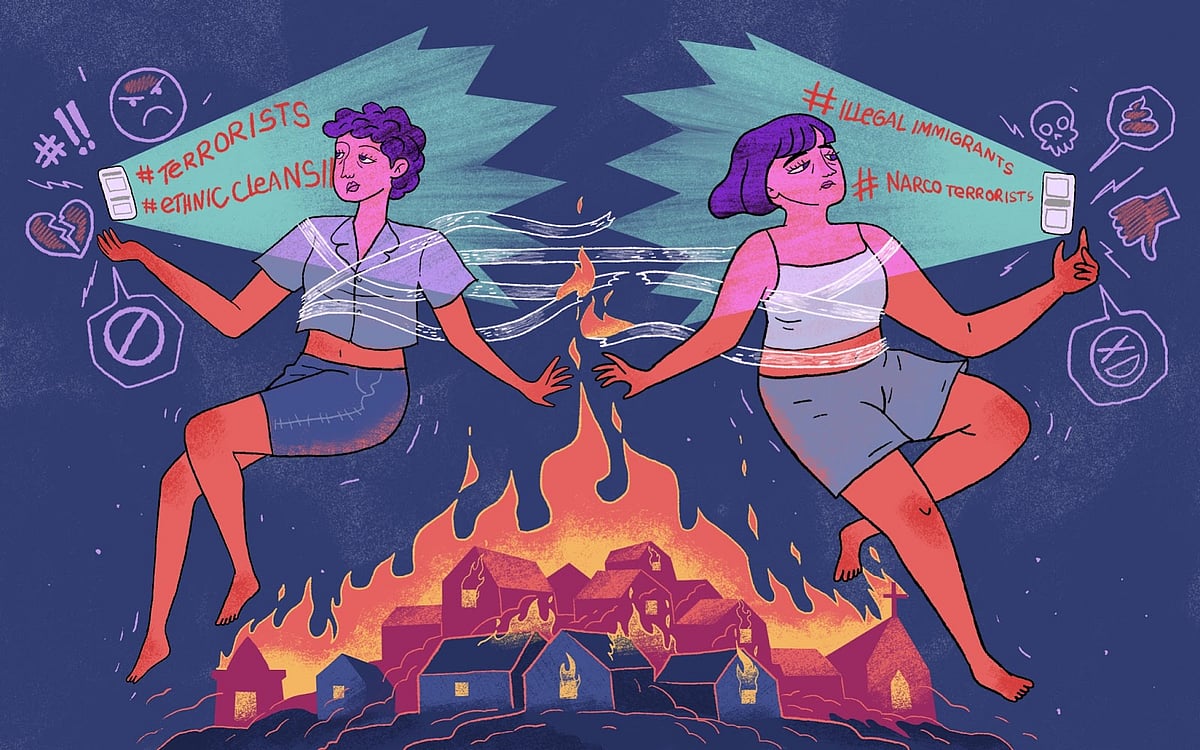
The ongoing civil war in Manipur, in India's Northeast, had been raging for three months when I called my friend Bom in July. She had had a very public falling out with a close friend, Suman. I was calling to check how she was doing. They were from different communities – Bom belongs to the Kuki tribe and Suman is Meitei – but when they first met they bonded over their shared childhood trauma of growing up queer in Manipur.
On 3 May, when violence broke out in Manipur between Meiteis and Kukis, Bom and Suman found themselves confused and enraged. Both felt the need to stand up for their own communities by becoming keyboard warriors and fighting what they saw as misinformation. Their friendship was abruptly over. They blocked each other on Instagram and cut off all contact.
As Bom and I began talking about the conflict and its ramifications on her personal life, she recalled how her friendship with Suman had always "felt like home". "It was probably the epitome of queer sisterhood," said Bom, who lives in Mumbai now.
Whenever one of them was feeling low, the other would help out. "If I was sick, she would come to my apartment and cook me food. If I was feeling hopeless and anxious, she would take me out to eat in restaurants to cheer me up. I did the same for her." Bom recalled fond memories of getting drunk with Suman and play-fighting over who would get to smoke the last cigarette. "At the time, it felt like meeting a long-lost family member," said Bom. Her voice was somber.