
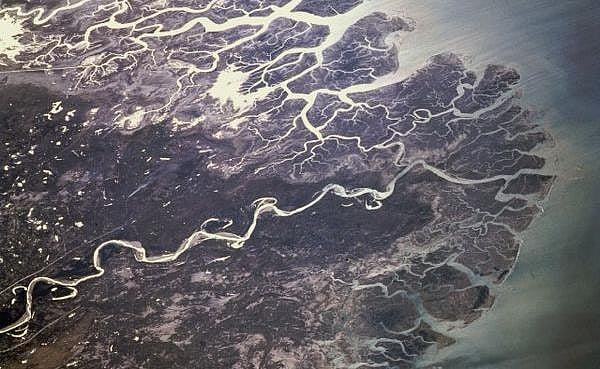
It has been found that most ancient communities shared deep-seated, multifarious and intricate links with rivers. Rivers have been the life-blood of civilisations, spawning them for time immemorial. Every riverbank endures the footprints of myriad different lives. Rivers have been of utmost importance to everyday human life due to the simple fact that they are sources of water, locomotion, trade and livelihoods. The multitude of ways in which humans interact with rivers makes them much more than just waterways. It is this realisation that induces immense respect for rivers in several societies.
Going beyond sustenance, rivers have also been sources of inspiration for creativity, symbols of enlightenment, sites for cultural activities and spiritual discourses. Intrinsic components in all rites of passage from birth to death, rivers seem to invoke both celebration and sorrow. So much a part of both the mundane and the sublime, they are simultaneously taken for granted, and deeply revered. This is especially the case in the Subcontinent, where rivers are elevated to the status of goddesses.
We find in cities today a trend of looking at the past to find one's roots in order to combat the alienation and rootlessness that urban and cosmopolitan sensibilities sometimes foster. Several books have been written in this vein: Empires of the Indus, The Lost River, and my own, In Search of Yamuna. The Indus People by Girja Kumar also responds to this mood of journeying into the Subcontinent's history to uncover the shared roots of India and Pakistan, which have more in common than either nation-state might want to believe. It is a cultural history of the north-western part of the Subcontinent, without viewing India and Pakistan as two separate countries but as a region watered by the Indus, and a civilisation cradled by the culture cultivated along and around this river. The main aspects of culture that this book touches upon are the Saraiki language accredited to the Indus basin, the Sufi-Bhakti cult, the legend of the Mahabharata, the Vedic and Sikh religions, and the various Punjabi communities and castes.
Attempting to trace this shared culture of language, literature, philosophical and spiritual discourse back to the Indus River, the book falls short of drawing substantive links between these different aspects and the river. While discussing the Indus, the book does not address how people of this region derive their identity from it, nor how the philosophical traditions and languages mentioned in the book are linked with the river. While discussing the Sufi-Bhakti cult, Kumar ignores the river's significance, as he does while discussing Saraiki identity. Failing to link concepts of language, culture, religion and region with each other and with the river, the book leaves the reader with several characters but no story of how they meet.